


Reviewed by ThaiLawOnline, a licensed Thai law firm practising in Thailand since 2006. Thai lawyer of record: Wichuda Atthamethakon, LL.M., Thai Bar Licence 3149/2556.
Last updated on
TL;DR. Under Thai law the longest enforceable land lease is thirty years. Any promise of automatic renewals to create a “30 + 30 + 30” or 90-year lease in Thailand is void. The Supreme Court has ruled several times that such pre-signed extensions are not binding. If you want long-term security, you need a strong thirty-year lease today. You need useful tools. These include a Thailand superficies, a usufruct agreement in Thailand, and a good succession clause. Be ready to negotiate new terms when it is time to renew.
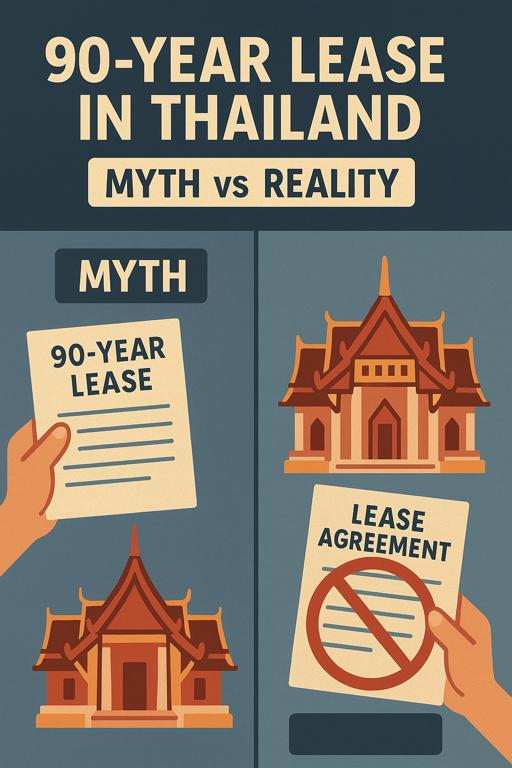
Table of Contents
THE 30 + 30 + 30 SALES PITCH
Resort-area agents often promise foreigners a guaranteed 90-year lease. You register thirty years now and sign two further leases “in escrow.” The idea sounds perfect: three decades of effortless living three times in a row. It feels safer than nominee company ownership, and the marketing material claims it is legal.
THE LEGAL CEILING: THIRTY YEARS ONLY
Section 540 of the Civil Code of Thailand says that a hire of immovable property cannot exceed thirty years, and that a longer term is cut down to thirty. The same section allows the term to be renewed once it has run out, but the renewed term cannot itself exceed thirty years counted from the date of renewal. Read it carefully, because the limit is on each term and on renewing in advance. The section does not cap how many times a lease may be renewed; what it refuses to allow is a renewal agreed before the current term has ended. Each new term has to be a fresh contract, signed and registered at the Land Department after the previous one expires. In decision 4655/2566 the Supreme Court struck down the standard workaround. A landowner had granted a thirty-year lease and, on the same day, promised two further thirty-year terms, with the rent for all ninety years paid up front at the same time as the rent for the first thirty. The Court held that the parties plainly intended to evade section 540, so the renewal part of the bargain was void. It then refused the tenant the fallback argument that the promise should at least bind the landlord personally, because if that worked section 540 would have no force at all. The tenant was evicted and lost the money paid for the extra sixty years.
THE 99-YEAR LEASE AND THE 75 PERCENT CONDOMINIUM QUOTA
Two separate measures are quoted to foreign buyers as though they were already law: raising the maximum lease term to 99 years, and raising the foreign ownership quota in a condominium building from 49 percent to 75 percent. Neither has become law. Section 540 still reads as set out above, and the thirty-year ceiling is what a Thai court applies to a lease signed today. Status checked on 22 August 2026.
So treat a 99-year offer exactly as you would treat a 90-year one: thirty years of enforceable right, followed by a hope. If a change is ever enacted it will not retroactively validate a structure a court has already struck down. Our page on the Thailand condominium foreign ownership quota tracks both proposals and records the stage each one has actually reached.
HIDDEN RISKS BEHIND THE 90-YEAR LEASE IN THAILAND MYTH
When the first thirty-year term expires the landowner, or whoever inherits the land, can simply refuse to renew. If the owner dies or sells, you lose leverage in the leasehold agreement. Without a succession clause, your lease can even end on your own death, leaving heirs with nothing in the case of a lease contract. Buyers who believe the 90-year promise often skip due diligence, forget to add protective rights and end up exposed.
SAFER LONG-TERM ALTERNATIVES
A registered superficies allows you to own the villa or house while leasing the land. This means that even if the lease ends, you still control the building. A usufruct grants lifetime possession and use, which is ideal for retirees considering a 30-year lease. Including a succession clause and writing bilingual Thai wills helps heirs inherit any remaining time on your lease easily.
TYPICAL COSTS AND REGISTRATION FEES
Government lease registration runs at 1.1 percent of declared rent for leasehold agreements. Drafting and translating a bilingual lease usually costs twenty-to-thirty thousand baht. A professional title search and due-diligence package for immovable property ranges from ten-to-twenty-five thousand. Compared with property values, these fees are modest insurance.
COMPANY OWNERSHIP VS. LEASE
Some advisers encourage Thai companies to pursue land ownership. However, nominee crack-downs and yearly compliance costs can often be more than the benefits. A thirty-year lease agreement can be beneficial. It may include superficies rights. This type of lease is often easier, cheaper, and better for a home.
FAQS about 90-Year Lease in Thailand
What is the legal status of a 90-year lease in Thailand?
In Thailand, a 90-year lease is not legally recognized. According to the Thai Supreme Court ruling, leases on property cannot exceed thirty years. Automatic renewals are considered void, meaning that any lease agreements suggesting a 90-year term are illegal and unenforceable.
Can a foreigner obtain a 30-year lease in Thailand?
Yes, foreigners can obtain a 30-year lease on property in Thailand. This type of leasehold is legally binding, and it can include a renewal option. However, it is essential for foreign investors to consult legal advice to ensure compliance with Thai property laws.
How does the lease renewal option work under Thai lease law?
The parties can negotiate a new lease once the first thirty years have run out, and a renewed term may itself run up to thirty years from the date of renewal. What cannot be done is to fix that renewal in advance. A renewal promised at the start of the lease was held void in Supreme Court decision 4655/2566. A reciprocal contract with special consideration beyond an ordinary lease is a genuine and separate doctrine in Thai law, but it does not lift the thirty-year ceiling; it matters because it can bind the landlord’s heirs and can be enforced even where the ordinary writing and registration rule in section 538 was not met. What section 538 actually costs you if you skip it is the rest of the term. A hire of immovable property for more than three years is enforceable only for three years unless it is made in writing and registered with the competent official. So a signed thirty-year lease that never reaches the land office is not a thirty-year lease with a paperwork problem: it is a three-year lease. And under section 564 a lease ends at the close of its agreed term automatically, with no notice required from either side, which is why nothing about a renewal happens by default.
What happens at the end of a 30-year lease in Thailand?
At the end of a 30-year lease, the lease may be renewed, but this renewal is not automatic. The parties must agree on the terms, and a new lease agreement must be drafted. This means that the property cannot be assumed to continue under the same lease unless both parties consent.
Are there any provisions for extending a lease in Thailand?
A lease can be extended, but the extension has to be a new agreement made after the current term ends, registered at the Land Department, and no longer than thirty years from the date of renewal. A reciprocal contract carrying special consideration beyond an ordinary lease is a real category in Thai law, built by the courts rather than written into a single section, and it rests on the mutual obligation rules in sections 369 to 376 of the Civil and Commercial Code. It is worth knowing about, because such a contract can bind the landowner’s heirs and can be enforced even when the lease was never registered. It does not, however, buy a term longer than thirty years, and it will not rescue a renewal that was agreed up front to get around section 540.
What should foreign investors know about property leases in Phuket?
Foreign investors who want to lease property in Phuket should know that the maximum lease period is 30 years. There is also a chance to renew the lease. It is advisable to seek legal advice to navigate the complexities of Thai property laws effectively.
What is the process for registering a lease with the land office in Thailand?
To register a lease with the land office in Thailand, both parties need to prepare the required documents. They must then submit these documents to the right land department. The lease agreement must clearly state how long it lasts. Any options to renew should also be noted to meet legal requirements.
Can a lease agreement be made for a longer term than 30 years in Thailand?
According to Thai law, lease agreements for immovable property cannot exceed thirty years. Any attempts to make a lease for a longer time would be illegal and not enforceable. This is confirmed by the supreme court’s rulings.
What legal advice should I seek before signing a lease in Thailand?
Before signing a lease in Thailand, it is important to get legal advice. This advice should cover the lease terms, renewal options, and property laws. It is important to understand the lease period. You also need to make sure the agreement is enforceable. This helps protect your investment. You may want to talk to a law firm. This will help ensure your documents are correct, especially if you are investing a lot of money.
Need a Lease Agreement in Thailand
Since 2006 ThaiLawOnline has drafted and registered hundreds of leases, superficies and usufructs. Schedule a consultation with us. Don’t rely on the 90-year myth. Secure your investment with a legally sound strategy today.
Try it yourself first, free
You do not have to book anything to get started. These run in your browser, and you only pay us if you decide you want a lawyer involved.
Last reviewed: 15 September 2026. Sections 538, 540, 541 and 564 of the Civil and Commercial Code were read in Thai and English from this site’s own statute library: section 540 for the thirty-year ceiling, for the reduction of any longer term to thirty, and for renewal not exceeding thirty years from the time of renewal; section 538 for the rule that a hire of more than three years is enforceable only for three years unless made in writing and registered; and section 564 for a lease ending at the close of its term without notice. Not verified in this review: the Supreme Court decisions cited above, the practical land office steps, and the commentary on structures marketed as ninety-year leases.
Lease Red-Flag Scanner Free
Paste your Thai lease. We check it against the five clauses that most often cause trouble.
Open the toolAsk our AI assistant Free
Trained on Thai law and 84,000+ Supreme Court decisions. Ask anything, free.
Thai Law Updates, free by email
Plain-English updates on Thai law changes that affect foreigners: property, visas, marriage, business and wills. One short email a month from a firm practicing since 2006. No spam, unsubscribe anytime.