


Reviewed by ThaiLawOnline, a licensed Thai law firm practising in Thailand since 2006. Thai lawyer of record: Wichuda Atthamethakon, LL.M., Thai Bar Licence 3149/2556.
Last updated on
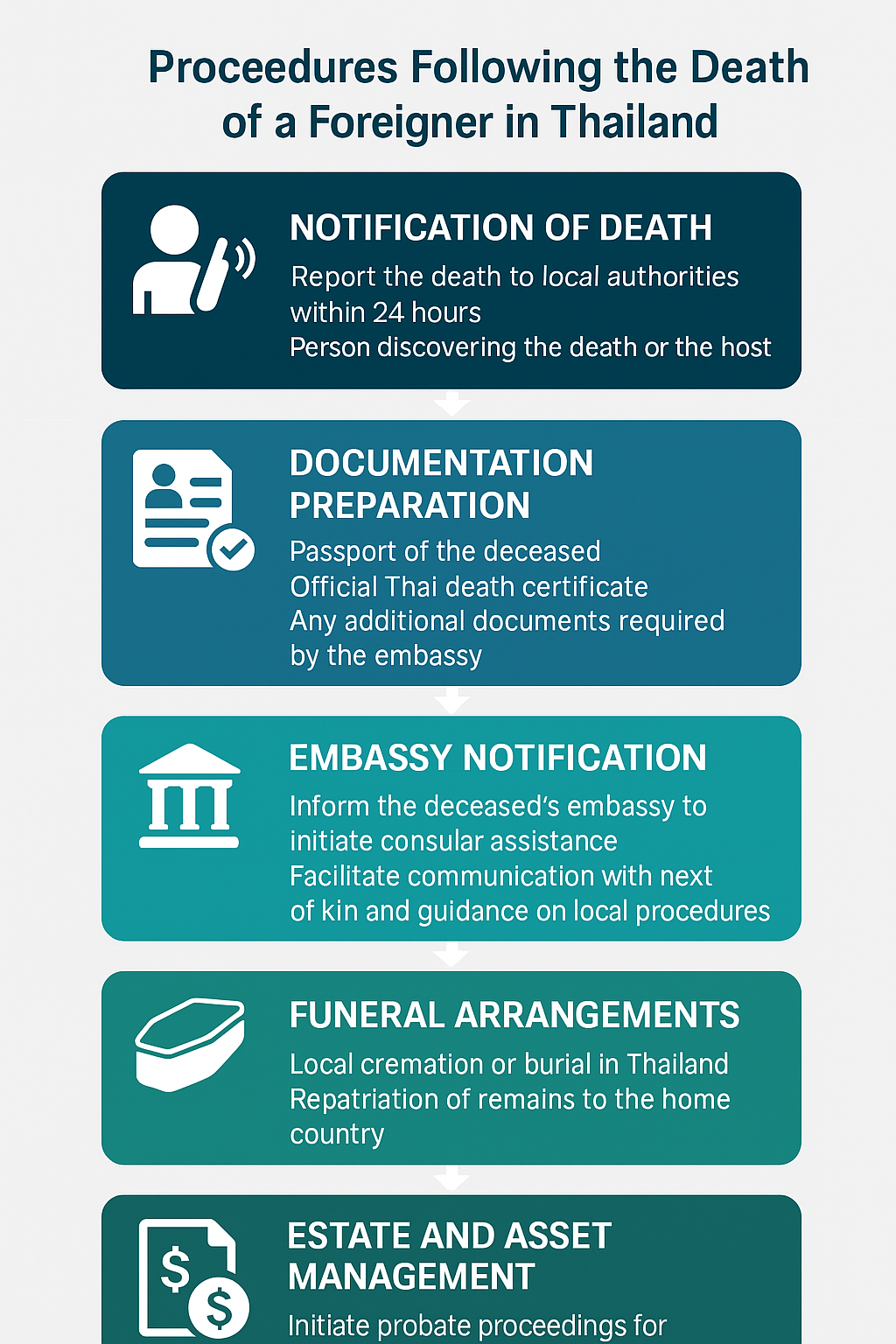
Short answer: report the death promptly, obtain the district death certificate, and confirm body-release and funeral arrangements with the hospital, police and the deceased’s embassy as applicable. Separately, secure the estate and establish who has authority to deal with each asset. Thai banks commonly require a Thai court appointment order, but Thai law also recognises an estate administrator appointed by will. The required route depends on the will, heirs, asset and receiving institution. A family relationship or access to the deceased’s PIN does not establish authority to withdraw money.
FREE DOWNLOAD, KEEP IT WHERE YOUR FAMILY CAN FIND IT
Death of a Foreigner in Thailand, Family Guide & Checklist (Word + PDF, English & Thai)
The family guide covers the first 24 hours, the Thai death certificate, what the embassy does, cremation or repatriation, the bank and the estate, with a checklist and a family record sheet. Complete English text first, then the complete Thai text. Checked 3 October 2026.
Download free Protect your family in advance: Thai will by our lawyers ฿3,900 →
In the first days: confirm who is reporting the death, contact the embassy and insurer, and ask the district registrar for the original certificate and the certified copies needed by identified recipients. Keep the estate secure. See the immediate steps below.
Our full guide to the estate side is Thai inheritance law for foreigners. This page is the practical sequence, from the death itself through to each asset.
Table of Contents
What Has to Happen in the First 7 Days?
The order matters, because each step needs the document produced by the one before it. Almost everything downstream depends on the Thai death certificate, so that is the priority.
| When | What happens | Who does it | What you come away with |
|---|---|---|---|
| Within 24 hours | The death is reported. In a hospital, the hospital notifies and issues the medical certificate of death. Anywhere else, or if the death was sudden or unnatural, the police are called first and attend. | Hospital, or the police plus the owner or person in charge of the house where the death occurred | Medical certificate of death, or a police report |
| Notify promptly, generally within 24 hours | Notify the responsible registrar within the applicable deadline. Confirm the evidence needed to complete death registration. | The legally responsible informant or an accepted authorised representative; confirm the route with the registrar | The district death certificate and any certified copies the registrar issues. Processing depends on the evidence and circumstances. |
| Day 1 to 3 | Notify the embassy or consulate of the deceased’s nationality. | Family, or the lawyer | Consular registration of the death, and in many cases a consular death record for use back home |
| Day 1 to 7 | If the death was unattended or not clearly natural, an autopsy is carried out and the body is released afterwards. | Institute of Forensic Medicine, or the provincial equivalent | Release of the body, and an autopsy report if requested |
| Day 2 to 7 | Choose repatriation or cremation in Thailand, and instruct a funeral director. | Family | A date, and a cost you can plan around |
| Day 3 onward | Have the death certificate translated and legalised if it will be used abroad, for a foreign pension, insurer, bank or probate registry. | Translator, then the Ministry of Foreign Affairs | A death certificate that a foreign institution will accept |
| Week 2 onward | Begin the estate: locate the will, list the Thai assets, and petition the Thai court to appoint an estate administrator. | Lawyer | The court petition filed. This is the long part. |
The DOPA registration guide generally requires death notification within 24 hours after death or discovery, with the responsible informant and reporting route depending on where the death occurred. The notification deadline differs from the time needed to issue documents. Confirm the report has been made; do not assume a hospital or hotel completed every step. Police and post-mortem requirements depend on the circumstances.
Get more copies of the death certificate than you think you need
List the recipients who need evidence of death, such as the embassy, funeral director, insurer, pension provider, bank or registry. Ask which require the original, a certified copy or a translated and legalised version. The British Embassy guide describes one original district death certificate; certified copies are a separate matter. There is no universal rule requiring five originals or five copies for every family.
What Does the Embassy Actually Do?
Embassies are helpful and they are not a solution. The distinction matters, because families arriving from abroad frequently expect the consulate to take charge, and it will not.
| The embassy will | The embassy will not |
|---|---|
| Notify the next of kin | Pay for the funeral, the cremation, or the repatriation |
| Explain the local process and the choices | Settle the deceased’s debts in Thailand |
| Liaise with Thai authorities and, where needed, the police | Act as executor or administrator of the estate |
| Explain any consular death-record or body-release procedure available for that nationality | Release funds from a Thai bank account |
| Provide a list of local funeral directors, translators and lawyers | Recommend or vouch for any one of them |
| Help arrange the transfer of money from family abroad to cover costs | Advance that money |
| Cancel and, in some cases, return the passport | Register the death for Thai purposes: that is the amphur’s job |
Take the passport and the Thai death certificate to the first appointment. If the deceased held two nationalities, contact both embassies: the estate paperwork at home may be simpler through one of them.
Repatriation or Cremation in Thailand?
This is the family’s decision and it is largely a financial one, made under time pressure and grief, which is a bad combination. The gap between the two options is wide.
| Repatriation of the body | Cremation in Thailand | |
|---|---|---|
| What is required | Embalming, an embalming certificate, a sealed zinc-lined coffin, the death certificate, airline approval, customs and export clearance | The death certificate and a crematorium booking |
| Typical timescale | One to three weeks, longer if an autopsy is involved | Days |
| Typical cost | Substantial. Quotes commonly run from roughly THB 150,000 to well over THB 400,000, driven by destination, airline and province. | A small fraction of that |
| Who pays | Ask the insurer and funeral director before committing. A family member may need to advance costs while estate authority or bank access is resolved. Reasonable funeral expenses are addressed by Section 1650 of the Civil and Commercial Code. | Check cover and keep itemised receipts. Embassy funding is not automatic. |
| Insurance | Check the actual policy, exclusions, authorisation process and destination. Repatriation cover varies; do not assume cover or exclusion from the policy label alone. | Check the policy and obtain approval where required. |
Cremation followed by taking the ashes home is by far the most common route for foreign deaths in Thailand, and the ashes can be carried by a family member or shipped. Burial is possible but unusual.
The cruel part of the timing is worth stating plainly. The funeral has to be paid for in the first fortnight, and the deceased’s Thai money cannot be reached for months. If the deceased was the only earner and their account is the only account, the family pays from its own resources and is reimbursed from the estate much later. Anyone with dependants in Thailand should hold a modest joint account for exactly this reason, and we say so on the Thai will page as well.
What Happens to Each Asset?
The estate devolves on heirs at death under Section 1599 of the Civil and Commercial Code. Establishing an entitlement differs from satisfying a bank or registry’s transfer requirements. Check authority, supporting records and the accepted procedure for each asset before instructing a transfer.
| Asset | What actually happens | What the heir needs |
|---|---|---|
| Thai bank account | Notify the bank and request its deceased-customer procedure. A spouse or foreign executor should not assume immediate access. Banks commonly require a Thai appointment order. | Death certificate, identity and succession documents, plus a court order where the bank requires one. Confirm the bank’s written requirements. |
| Joint bank account | Practice varies by bank and by how the account was opened. Some release the survivor’s share; many freeze the whole account pending the court order. | Ask the branch early. Do not assume. |
| Condominium unit | A foreign heir can inherit the unit, but can only keep it registered in their own name if the building’s 49% foreign quota allows. If it does not, or if the heir does not qualify, the unit must be disposed of, and the Land Department can sell it if the heir does not. | Court order, plus the juristic person’s written confirmation of the quota position |
| Land, or a house on land | Foreign ownership restrictions remain. Section 93 of the Land Code provides a restricted permission route for a foreign statutory heir; inheritance does not itself authorise registration. Where retention is not permitted, disposal requirements apply. Building ownership needs separate examination. | Check the Department of Lands Section 93 procedure, eligibility, permission and any disposal deadline with the responsible Land Office. |
| Vehicle | Ask the Department of Land Transport which inheritance-transfer route and evidence apply. Preserve the registration book and check tax and insurance. | Death certificate, registration book, heir or administrator evidence, and a court order where required by the applicable procedure. |
| Company shares | Review the shareholder register, articles and succession evidence. A vacant authorised-director position requires separate corporate action; inheriting shares does not automatically appoint a director. | Succession and authority records, lawful share-register changes, and the resolutions and DBD filings required for a director change. |
| Life insurance | The important exception. Where the policy names a specific beneficiary, the sum insured goes to that person and is not part of the estate. Section 897 leaves one thing behind: the premiums the deceased actually paid still form part of the estate and creditors can claim against those. Where the policy simply says “my heirs” without naming anyone, section 897 of the Civil and Commercial Code puts the money into the estate, where creditors can. The wording on an old policy is worth checking now, not later. | Death certificate and the policy. Usually no court order needed if a beneficiary is named. |
| Foreign pension | Governed by the home country, not by Thailand. Stop it promptly: overpayments after death are reclaimed, sometimes aggressively, and sometimes from the widow’s own account. | Legalised and translated death certificate |
| Rented home | The lease does not end automatically on death. The deposit and any notice period remain due. | Talk to the landlord in the first week |
| Phone, utilities, subscriptions | Keep the electricity and water on if anyone still lives there, and if the condominium is empty keep paying the common area charges. Arrears block a later transfer at the Land Office. | Nothing formal, but do not let them lapse |
| Pets | No legal mechanism protects them. Somebody has to decide in the first days. | A named person, agreed in advance if possible |
When a Court Appointment Is Needed
Separate the source of an administrator’s legal authority from the evidence a bank or registry requires before acting.
Section 1711 of the Civil and Commercial Code recognises administrators appointed by will or by court. Section 1713 provides for a court petition in the circumstances specified there, including obstacles to administration and ineffective appointment provisions. An heir, interested person or public prosecutor has the petition route specified by that section. In practice, banks and registries frequently require a Thai court order for the proposed transaction. A foreign grant should not be assumed to satisfy those requirements. Section 1718 separately excludes persons disqualified from acting as administrator.
Where a court application is needed, produce the will, proposed administrator’s qualifications and complete heirship evidence. A nomination helps identify the proposed administrator but does not guarantee an uncontested appointment or a short hearing. Without an effective disposition, the statutory heirs and surviving spouse’s entitlement require assessment under Sections 1629 and 1635. Cross-border records and disputes affect the timetable.
There is also a deadline that surprises people. Under section 1754, an heir’s claim to the estate is generally barred one year after they knew or ought to have known of the death. We have written up a recent decision on exactly that point in Thai inheritance claims after one year, Dika 284/2569. If the family is abroad and assumes there is no rush, the year runs anyway.
The mechanics of the court process, the documents, and the typical timeline are set out in our probate and estate administration guide. If the will was made abroad, see probate of a foreign will in Thailand.
Proving You Are the Heir When the Marriage or Birth Happened Abroad
A cross-border family has an extra hurdle: the Thai court needs to be satisfied that a foreign marriage or a foreign birth actually creates the relationship claimed. It can be, and routinely is.
In Supreme Court Decision 170/2569, a widow opposing another applicant’s appointment as administrator produced a certified copy of a Florida marriage record with a translation, plus a certificate from the Clerk of the Court of Miami-Dade County confirming the copy was genuine. The Supreme Court held that under section 1459 paragraph one of the Civil and Commercial Code a marriage abroad where at least one party is Thai may be celebrated in the form prescribed by Thai law or by the law of that country, and under section 20 paragraph two of the Conflict of Laws Act B.E. 2481 such a marriage is valid in Thailand. Where both spouses are foreign nationals that section does not apply and the marriage is proved a different way, but the evidential point below is the same. She was therefore the lawful wife and an heir entitled to inherit.
The practical lesson is about evidence, not law. What carried it was a properly certified copy from the issuing authority, with a translation. The same applies to foreign birth certificates for children and to foreign divorce decrees where an earlier marriage has to be shown to have ended. Gather these early, have them legalised, and expect the process to take weeks; our document legalisation guide explains the route.
What Does It Cost and How Long Does It Take?
| Item | Typical timing | Fee |
|---|---|---|
| Death certificate at the amphur | Same day to 3 working days | Nominal government fee |
| First consultation, so somebody tells you the order of events | 1 to 2 business days | 2,000 THB per hour |
| Probate: petition to appoint an estate administrator | Several months from filing to order, longer without a will or with a contest | Tiered, individual quote once the estate is listed |
| Dealing with banks, Land Office and Land Transport after appointment | Weeks | Quoted with the probate work |
| Making a Thai will, for those still reading this in time | 3 to 5 business days | 3,900 THB |
| Safekeeping of the original will at our office | Ongoing | 1,000 THB |
Government court fees and translation and legalisation costs are separate and depend on the size of the estate and the documents involved.
The One Thing That Changes All of This
A properly coordinated Thai will records the intended beneficiaries and administrator for Thai assets. It does not guarantee immediate bank access or eliminate a necessary court application. Equally, there is no rule that every asset in every estate must await a court appointment. Check the will’s interaction with foreign wills and the transaction requirements of each institution.
If you live in Thailand and have anything here at all, a bank account, a car, a condominium, a company share, this is the kindest paperwork you will ever do for the people who will have to sort it out. See making a Thai will, our free bilingual will template, and if you also have a will at home, how a Thai will and a foreign will work together. What happens when there is no will is set out in dying without a will in Thailand.
Common Questions
What happens if a foreigner dies in Thailand?
Report the death promptly and complete district registration. Confirm body-release and funeral requirements with the responsible authorities and embassy. Separately, secure the estate and establish authority for each asset. A court appointment is often needed in practice, particularly for bank release, but it is not a universal statutory prerequisite for every asset.
Can my wife access my Thai bank account when I die?
Marriage alone does not authorise access to an account held solely by the deceased. Notify the bank and obtain its written succession-document requirements; a Thai court appointment order is commonly required. Joint accounts have separate terms and procedures. Do not use the deceased’s PIN or online credentials as a substitute for authority.
How long does the whole process take?
Medical and police enquiries, body release, document completeness, embassy procedures and funeral arrangements determine the immediate timetable. Estate administration depends on the assets, required court proceedings and any dispute. Obtain a case-specific estimate; a fixed minimum or maximum is not reliable.
Is a foreign will valid in Thailand?
A foreign will requires assessment of validity, applicable law, translation and any certification requirements. Section 1711 recognises appointment by will, but a foreign nomination or grant does not guarantee acceptance by a Thai institution. A Thai court order is often required for practical administration. Coordinate any Thai will with existing foreign wills to avoid unintended revocation.
Can a foreign heir inherit a condominium in Thailand?
Yes, subject to the building’s 49% foreign ownership quota. If registering the unit in the foreign heir’s name would breach the quota, or the heir does not qualify to hold it, the unit has to be disposed of, and the Land Department can sell it if the heir does not act. Get the quota position in writing from the juristic person early.
Can a foreign heir inherit land or a house in Thailand?
Foreign ownership restrictions continue after inheritance. Section 93 of the Land Code provides a restricted permission route for a foreign statutory heir, subject to conditions and area limits. Where lawful retention is unavailable, disposal requirements apply. Building ownership is a separate question. Obtain the Land Office’s assessment promptly.
Does life insurance form part of the estate?
It depends on the wording. Where the policy names a specific beneficiary, the sum insured is paid to that person and is outside the estate. Only the premiums the deceased actually paid remain part of the estate and within reach of creditors. Where the policy is simply payable to “my heirs” with nobody named, section 897 of the Civil and Commercial Code treats the proceeds as part of the estate and creditors can claim against it.
Is there a deadline to claim an inheritance in Thailand?
Inheritance claims have short and claim-specific limitation rules. Section 1754 generally provides a one-year period and a ten-year long-stop, with different starting points for different claims and relevant exceptions elsewhere in the Code. Possession and administration disputes need separate analysis. Have the earliest applicable deadline checked promptly.
Who pays for the funeral or repatriation?
Check the insurer’s cover and obtain written funeral quotations. A family member may need to advance costs while authority or account access is being resolved. Reasonable funeral expenses are addressed by Section 1650; keep receipts and distinguish an estate expense from a personal promise to pay. The embassy does not ordinarily fund the funeral.
We are abroad. Do we have to fly to Thailand?
Usually not immediately. A Thai lawyer acting under a power of attorney, working alongside the embassy, can register the death, obtain and legalise the certificates, instruct a funeral director and file the court petition. Someone normally attends at some stage, but the first week can be handled remotely.
How We Help
We act for families dealing with a death in Thailand, very often from abroad and in a different time zone. That means obtaining and legalising the death certificate, coordinating with the embassy and a funeral director for repatriation or cremation, and then the estate: petitioning the court to appoint the administrator, and afterwards dealing with the banks, the Land Office, the Department of Land Transport and any company shares.
If you are in the first days, the useful first step is a short consultation at 2,000 THB per hour so that somebody sets out the order of events and tells you what can wait. Probate is quoted individually once the estate has been listed. Our published legal fees and pricing are online.
Contact us in English, French or Thai.
Email: info@thailawonline.com | Phone: +66 87 225 1340 (English and French), +66 87 414 9288 (Thai and English). We work by appointment, including outside Thai office hours for families in other time zones.
This page states the position as at August 2026 and is general information, not advice on your situation. Statutory references are to the Thai Civil and Commercial Code unless stated otherwise. Repatriation figures are indicative market quotes, not our fees.
Last reviewed: 5 September 2026. No corrections were needed. Every Civil and Commercial Code citation on this page was checked against the statute text: section 1754 (an inheritance claim is barred one year after the heir knew or ought to have known of the death), section 897 (a named beneficiary takes the sum outside the estate and only the premiums paid fall into it, while a policy payable simply to the heirs falls into the estate), sections 1711 to 1713 on appointing an administrator, section 1718 on who cannot be appointed, and the six classes of statutory heir in section 1629. All fifteen links on the page resolve. Re-checked on 6 October 2026: Civil and Commercial Code sections 1459 and 1650 and Supreme Court Decision 170/2569 read in Thai; the account of the Florida marriage evidence and the funeral-expense rule match; nothing changed.
Thai Law Updates, free by email
Plain-English updates on Thai law changes that affect foreigners: property, visas, marriage, business and wills. One short email a month from a firm practicing since 2006. No spam, unsubscribe anytime.