


Reviewed by ThaiLawOnline, a licensed Thai law firm practising in Thailand since 2006. Thai lawyer of record: Wichuda Atthamethakon, LL.M., Thai Bar Licence 3149/2556.
Last updated on
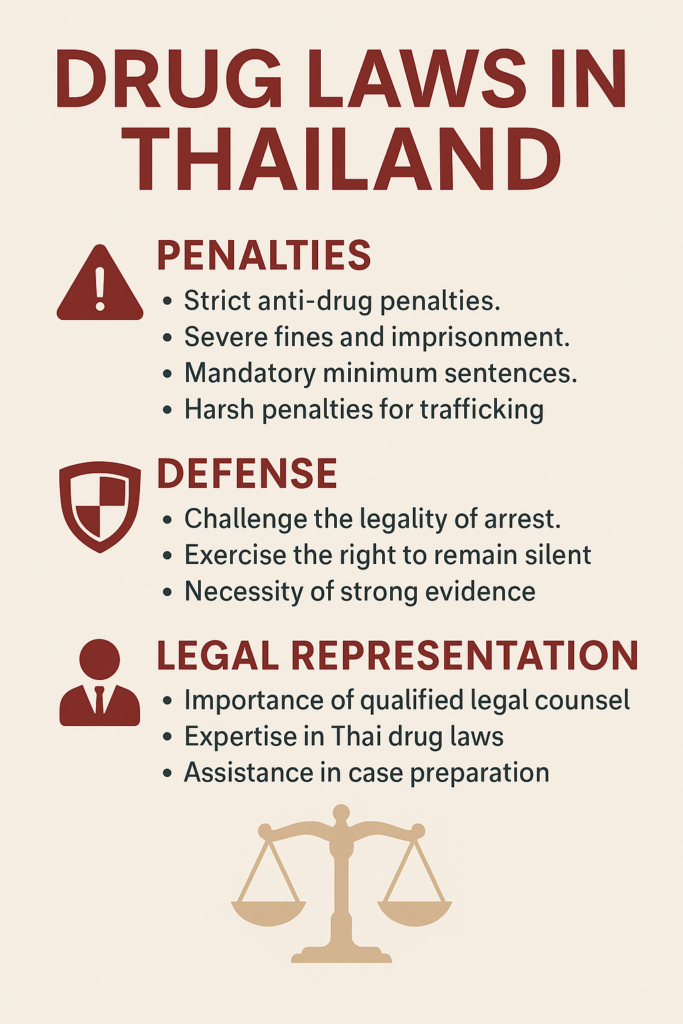
Thailand’s drug laws are notoriously strict, one wrong move could mean years in prison or worse. As an expat, understanding them isn’t optional; it’s essential. Even a single pill can put you behind bars, while large-scale trafficking still attracts the death penalty. Recent reforms have adjusted limits and added rehabilitation options. The main point is clear. Selling or using illegal drugs is treated as a serious threat to national security. It is important to understand the drug laws in Thailand if you live in or visit the country. If you are a foreigner and have been arrested in Thailand, click on this guide.
Table of Contents
For how a drug case fits into the wider process, see our overview of criminal law in Thailand.
Here is a detailed guide for expatriates and long-term visitors. It explains how the law works and what penalties you might face. It also covers recognized defenses and why hiring a specialized Bangkok drug lawyer is important if you get arrested.
This guide on Drug Laws in Thailand will help you navigate the complex legal landscape. Facing charges? Contact us for expert Bangkok drug lawyer support.
Looking for the penalty tables? Sentencing ranges by drug category and quantity, the presumption of intent to supply, and the 2024 to 2026 changes are set out in full in our reference guide to Thailand drug laws, penalties and trafficking offences. This page is about what to do when someone has actually been arrested.
Table of Contents
1. Understanding Drug Laws in Thailand
Thailand’s narcotics regime is built on three pillars: personal use, trafficking, and possession under Thai law.
- The Narcotics Act B.E. 2522 (1979) and the Psychotropic Substances Act B.E. 2559 (2016) were repealed, along with nineteen other instruments, by section 4 of the Act Promulgating the Narcotics Code. Both subjects now sit in the single Narcotics Code, the “Narcotics Code B.E. 2564 (2021)”. The Act was published on 8 November 2021 and took effect the following day; the Code annexed to it took effect thirty days later, on 9 December 2021.
- Five categories of narcotic under section 29, from Category I down to Category V, and a separate scheme of four categories of psychotropic substance under section 30. The Code gives examples only: which named substance sits in which category, and any move between categories, is fixed by notification of the Minister of Public Health, not by the Code.
- Parallel offences for possession, use, manufacture, import/export and trafficking of drugs in Thailand, each carrying sharply escalating penalties including years imprisonment.
Key 2024-25 updates
- The quantity of methamphetamine presumed to be held for personal consumption was cut from five dosage units to one, by Ministerial Regulation (No. 2) B.E. 2567 of 17 June 2024. One tablet is inside that presumption, not outside it; carrying more simply removes the presumption, and the prosecution must then prove what the drug was for.
- Cabinet proposal to re-list recreational cannabis as a narcotic; sales now restricted to medical prescription only.
- New sentencing bands let judges shorten jail terms. This is possible if the crime is “serious” but not “aggravated” under the 2021 Code.
2. Penalties by Category related to Drug Laws in Thailand
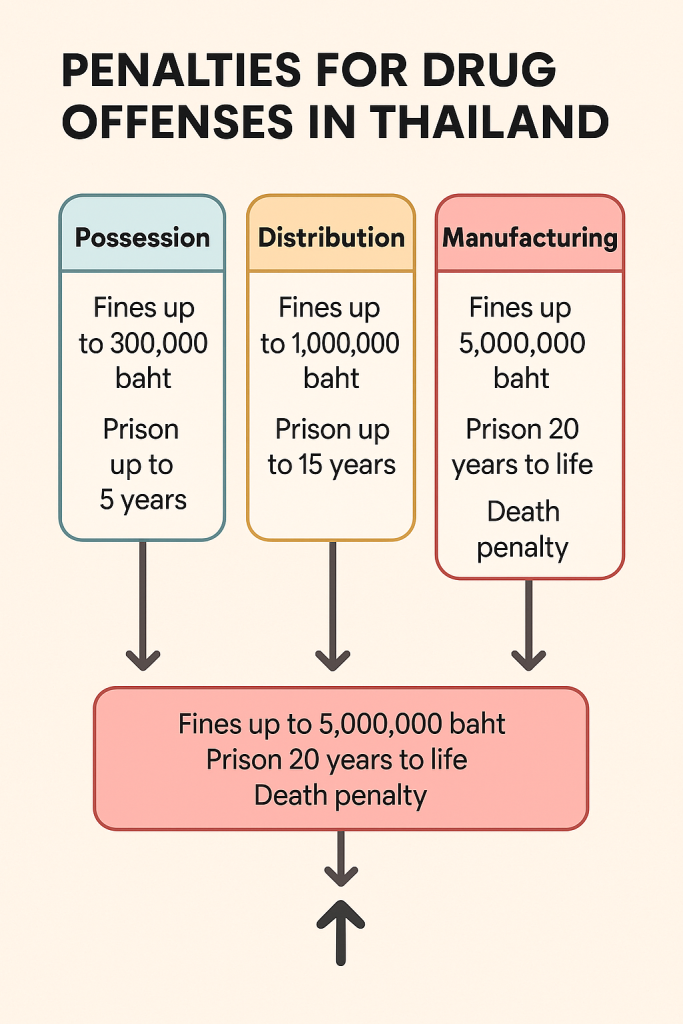
| Category and Code sections | Producing, importing, exporting, disposing of or possessing it, basic penalty | Where the act is for trade or is otherwise aggravated | Notes |
| I, severe narcotics. Section 29(1) names heroin; methamphetamine and MDMA are placed here by notification, not by the Code. Offence s.90, penalty s.145 | Imprisonment not exceeding 15 years and a fine not exceeding 1,500,000 THB | 2 to 20 years and a fine of 200,000 to 2,000,000 THB. Where the offender is a chief, a person with authority to give orders or a person with managing authority in a criminal network, or where the act affects the security of the State or the safety of the general public: 5 years to life imprisonment and a fine of 500,000 to 5,000,000 THB, or death | Holding a Category I drug for your own consumption is a separate and far lighter offence. See the paragraph below the table |
| II, general narcotics. Section 29(2) names morphine, cocaine, codeine and medicinal opium. IV, chemicals used to produce a Category I or II narcotic, s.29(4) naming acetic anhydride. Offence s.91, penalty s.146 | Imprisonment not exceeding 10 years and a fine not exceeding 1,000,000 THB | 1 to 15 years and a fine of 100,000 to 1,500,000 THB, for Category II only. Section 146 gives Category IV no aggravated tier at all | Categories II and IV share one offence provision and one basic penalty. Category IV is not treated more lightly than Category II at the basic level |
| III, preparations containing a Category II narcotic, e.g. codeine mixtures. Offence s.92, penalty s.147 | Imprisonment not exceeding 3 years and a fine not exceeding 300,000 THB | None. Section 147 has no aggravated tier | Section 92 does not prohibit possession. It reaches producing, importing, exporting and disposing only, so simply holding a Category III preparation is not an offence under this head |
| V, narcotics not falling in Categories I to IV, s.29(5) naming the opium plant. Offence s.93, penalty s.148 | Imprisonment not exceeding 5 years and a fine not exceeding 500,000 THB | 1 to 15 years and a fine of 100,000 to 1,500,000 THB | Cannabis is no longer in this category: it was removed by Ministry of Public Health notification of 9 June 2022 made under section 29 paragraph two. See is marijuana legal in Thailand |
*Read the table with four things in mind, all of them from the Code itself. First, the fine is cumulative, not alternative. Sections 145 to 148 each read “imprisonment … and a fine”, so a court sentencing under one of them imposes both. Second, the aggravating limbs are the same six in sections 145, 146 and 148: the act is done for trade; it causes the drug to spread among the public; the drug is disposed of to a person not over eighteen; it is disposed of in an educational institution, a place of religious veneration or a government place; force or the threat of force is used; or the offender is armed or uses a weapon. Only section 145 adds the third tier shown above. Third, the Code grades by conduct and by the offender’s role, not by weight. There is no quantity threshold anywhere in sections 145 to 148, and quantity matters as evidence of what the drug was for rather than as a sentencing band. Fourth, section 165 directs the court, in these cases, to weigh helping the defendant stop using narcotics through treatment above punishing them, and to sentence each defendant individually even where they offended together.
Two lighter offences sit outside the table, and they are the ones most expats actually face. Consuming a Category I, II or V narcotic, or a Category I or II psychotropic substance, breaches section 104 and is punishable under section 162 by imprisonment not exceeding one year, or a fine not exceeding 20,000 THB, or both. Possessing one for your own consumption breaches section 107 and is punishable under section 164 by imprisonment not exceeding two years, or a fine not exceeding 40,000 THB, or both. Section 107 paragraph two makes a quantity below the amount fixed by ministerial regulation presumed to be held for consumption. In these two provisions the fine is an alternative to prison, which is the opposite of sections 145 to 148.
Psychotropic substances are a separate scheme with four categories, not five. Section 30 divides them by medical use and abuse potential, and section 94 prohibits producing, importing, exporting, disposing of, possessing or transiting them without a licence. Section 149 sets the penalties: Category 1, imprisonment not exceeding 10 years and a fine not exceeding 1,000,000 THB; Category 2, not exceeding 7 years and 700,000 THB; Categories 3 and 4, not exceeding 5 years and 500,000 THB. For Categories 1 and 2 the same six aggravating limbs raise it to 1 to 15 years and 100,000 to 1,500,000 THB.
3. What Really Happens After an Arrest
3.1 Police Phase (0-48 hrs)
- Police may search without warrant if they claim exigent circumstances; challenge illegal searches early.
- Confession culture is strong; remain polite but exercise your right to silence until your lawyer arrives.
- Bail for minor drug offences can be paid at the station. Serious drug charges need a Criminal Court hearing and a high bond.
3.2 Investigation & Remand (Day 3, Day 84)
- Judges can extend detention in 12-day blocks up to 84 days before prosecutors file charges.
- During this time, your defense team should review evidence, conduct forensic tests, and interview witnesses. They should already be testing the state’s case.
3.3 Trial & Sentencing
- No jury system; panels of professional judges decide fact and law.
- For charges carrying ≥5 years, judges must require corroborative proof even after a guilty plea.
- Sentencing mitigants include: cooperation, first-time offence, proven addiction, entrapment, duress, improper search, or violation of statutory procedures.
- Appeals must be lodged within 30 days; fresh evidence sometimes admissible on appeal.
4. Common Defenses and Mitigation Strategies
- Lack of knowledge / possession not proved, Useful where drugs in Thailand are found in shared accommodation or vehicles.
- Entrapment or controlled delivery gone wrong, Increasingly relevant with online sting operations.
- Duress / Necessity (Penal Code §67), Frequent in “drug-mule” scenarios involving opium.
- Procedural violations, Unlawful search, unsigned inventory, absence of translator during interrogation.
- Addiction and Rehabilitation, Under the 2021 Code, small-quantity users may petition for mandatory treatment instead of prison.
- Plea negotiation with police , Thai prosecutors do not have U.S.-style plea-bargaining power. Charge-reduction talks occur during the police investigation stage.
5. Special Risks for Foreigners
- Blacklists & Overstay, Any drug conviction triggers deportation and up to a lifetime re-entry ban.
- Prison Transfers, Transfer to home country possible only after serving one-third (or four years) of sentence and paying all fines.
- Extradition, Thailand will extradite foreigners for drug trafficking under bilateral treaties, but will not surrender Thai nationals.
- Asset Seizure, Narcotics Code mandates aggressive forfeiture of cars, condos and crypto suspected of being drug proceeds.
- Death-Penalty Cases, Foreign nationals have been condemned. The Malaysian national Ong Gim Wah was sentenced to death on 4 March 2025, following a 2023 seizure in Ratchaburi of 998 kilograms of crystal methamphetamine. That was a sentence of a court of first instance and is subject to appeal, so it is not a final sentence. Executions are rare under a de facto moratorium, but the penalty remains on the books.
6. Choosing a Bangkok Drug Lawyer
- Language & Court Experience, Court-appointed counsel often lack English-fluency and trial depth. Select counsel with a record in high-weight drug cases and interpreter support.
- Early Engagement, The first 48 hours are crucial for bail options and charge framing. A delay can lead to harsher drug offence penalties.
- Bail Strategy, Counsel must craft surety packages (cash, land titles) and flight-risk arguments tailored for foreigners
- Evidence-Testing Capability under Thai law., Access to independent labs and experts to challenge purity levels and weights can slash potential sentences.
- Appeal & Deportation Counsel, Same firm should be able to handle sentence reduction petitions, prisoner-transfer applications, and liaise with your embassy.
7. Practical Compliance Tips for Expats
- Travel with prescriptions for personal use of medications., Obtain FDA permits in advance for any medication containing codeine, diazepam or similar controlled ingredients.
- One-Pill Rule, one dosage unit, or a net weight of 100 mg, or 20 mg where the drug is in flakes, powder or crystals, is the quantity presumed to be held for consumption. Carrying more does not make you a presumed seller and does not close off treatment: it removes the presumption, so the purpose becomes a matter of proof.
- Cannabis Is Not a Free Pass, You can only buy cannabis at licensed clinics. Smoking in public can still lead to fines or jail time under nuisance laws.
- Night-Life Hotspots, Random urine tests for drug use happen often at clubs and private parties. A positive result can lead to prosecution.
- Digital Footprint, Police are using chat apps and delivery-service data more often in drug stings. To protect yourself, encrypt and delete your devices or, even better, avoid using them.
- Asset Paper Trail for drug use and trafficking cases., Large unexplained transfers from overseas can be frozen pending money-laundering probes linked to narcotics.
8. FAQS about DRUG LAWS IN THAILAND
What are the drug laws in Thailand regarding psychotropic substances?
Psychotropic substances are no longer governed by the Narcotics Act B.E. 2522, which section 4 of the Act Promulgating the Narcotics Code repealed, nor by the Psychotropic Substances Act B.E. 2559, repealed by the same section. They sit in the Narcotics Code B.E. 2564, which divides them into four categories under section 30. Section 94 prohibits producing, importing, exporting, disposing of, possessing or transiting them without a licence, and section 149 sets the penalty: up to 10 years and a fine up to 1,000,000 THB for Category 1, up to 7 years and 700,000 THB for Category 2, and up to 5 years and 500,000 THB for Categories 3 and 4. Consuming a Category 1 or 2 psychotropic substance is a separate offence under section 104, punishable under section 162 by up to one year, or a fine up to 20,000 THB, or both.
What is the penalty for drug offenses in Thailand?
The penalty for drug offenses in Thailand can be severe, often resulting in years in prison. For serious drug crimes like trafficking, the punishment can be life in prison or even death. This depends on the type and amount of drug involved. Possessing drugs for personal use can lead to jail time. However, the punishment depends on the type of drug.
How does the law classify drugs in Thailand?
There are two schemes, and neither has two categories. Section 29 of the Narcotics Code divides narcotics into five categories: I, severe narcotics, the section naming heroin; II, general narcotics, naming morphine, cocaine, codeine and medicinal opium; III, preparations containing a Category II narcotic; IV, chemicals used to produce a Category I or II narcotic, naming acetic anhydride; and V, narcotics falling in none of the others, naming the opium plant. Section 30 separately divides psychotropic substances into four categories by medical use and abuse potential. Which named substance sits in which category is fixed by notification of the Minister of Public Health, not by the Code.
What are the consequences of drug smuggling in Thailand?
Drug smuggling is treated as a serious offense in Thailand, with severe penalties including long-term imprisonment. The laws are designed to deter trafficking activities, and the government has adopted measures for suppressing narcotic offenders. Importing and exporting are not graded separately in the Narcotics Code: sections 90 to 93 list them beside producing, disposing and possessing, so the penalty is the one for the category. For a Category I narcotic that is up to 15 years and a fine up to 1,500,000 THB under section 145, rising to 2 to 20 years where the act is for trade and, for a network leader or where the security of the State is affected, to 5 years to life or death. They may also face fines and lose money made from drug trafficking.
Can legal services in Thailand help with drug-related offenses?
Yes, legal services in Thailand, such as those offered by ThaiLawOnline, can assist individuals facing drug-related offenses. These services provide legal help and advice. They focus on understanding the complex laws about drug possession, trafficking, and other drug-related offenses. It is advisable to seek professional legal assistance if suspected of drug involvement.
What are the implications of drug possession for personal use?
Possessing drugs for personal use is still illegal in Thailand. People caught with illegal drugs can face serious penalties. Even small amounts can result in imprisonment and fines, reflecting the country’s strict stance on drug enforcement. It is important to be aware of these laws to avoid serious legal consequences.
What should I know about drug tests in Thailand?
Drug tests in Thailand are commonly conducted in various settings, including workplaces and law enforcement situations. If you test positive for illegal drugs, you may face legal consequences. These can include fines or jail time, depending on the situation and the drug. Awareness of drug laws is essential for those living or traveling in Thailand.
9. How the Supreme Court Has Applied the 2021 Narcotics Code
Two Supreme Court decisions govern how the 2021 Code changed sentencing, and they are worth reading together because they cut in opposite directions. Neither is a general promise of leniency. Both are rulings about which law applies to conduct that straddles the Code’s commencement on 9 December 2021, which is the question that decides a great many drug cases still moving through the courts.
- Decision 272/2565, the Supreme Court sitting as a Grand Chamber: quantity is no longer the criterion. The Court held that the former Narcotics Act B.E. 2522, section 15 with section 66, imposed a heavier penalty by taking the quantity of the drug alone as decisive, whereas section 145 of the Code imposes a heavier penalty by reference to the offender’s conduct in committing the offence and their role and duty in it, and no longer takes quantity as the old law did, although a greater quantity may itself indicate that conduct and role. The consequence the Court drew is exact: where the quantity reaches the old section 66 paragraph two or three but the offender has none of the conduct or role described in section 145 paragraph two or three, the court may convict only under section 145 paragraph one.
- The same decision holds the other half, and it is the half a defendant is more likely to be hurt by. Section 21 paragraph one of the Act promulgating the Code keeps the old presumption of possession for sale in force for any case in which the trial court gave judgment before the Code commenced, until that case becomes final. So a defendant sentenced at first instance before 9 December 2021 still faces the old section 15 presumption, under which possessing a Category I narcotic in the specified quantity, for amphetamine 375 milligrams or more calculated as pure substance, is presumed to be possession for sale.
- Decision 4302/2567: for consumption offences the more favourable law applies, and it is the Code. Penal Code section 3 decides which law governs conduct committed before a change. Consuming methamphetamine was an offence under section 57 of the 1979 Act, punished by its section 91 with 6 months to 3 years, or a fine of 10,000 to 60,000 baht, or both. The same conduct is now section 104 of the Code, punished by section 162 with not more than 1 year, or a fine of not more than 20,000 baht, or both. Section 162 is more favourable, so it governs. Because section 157/1 paragraph two of the Road Traffic Act B.E. 2522 raises the narcotics penalty by one third for a driver who has consumed, the ceiling there works out at 1 year 4 months, or a fine of 26,666.66 baht, or both. On that count the defendant was sentenced to 3 months, suspended for 2 years.
What this does and does not mean for you. Section 165 of the Code directs a court hearing these offences to weigh helping the defendant stop using narcotics through treatment above punishing them, and to sentence each defendant individually even where they offended together. That is a real instruction to the court and it is why mitigation, treatment and a clear account of your role matter more under the Code than they did under the 1979 Act. It is not a guarantee, and for anyone whose case began before December 2021 the old presumption in 272/2565 may still be the thing that decides it.
These outcomes show that while drug laws remain strict, outcomes can improve with evidence-based defenses. At ThaiLawOnline, our team is led by Sebastien H. Brousseau. We have licensed Thai lawyers, like Garn (barrister), JJ, and Wichuda (who has a master’s degree). We have used similar cases to help secure reductions, acquittals, and rehabilitation options. Don’t navigate this alone. Contact us at info@thailawonline.com for personalized advice on how these rulings might apply to your situation.
Last reviewed: 5 September 2026. The penalty table and the classification statements on this page were read against the Narcotics Code B.E. 2564 itself, from the Royal Gazette publication of 8 November 2021 (volume 138, part 73 Kor, page 1), which carries the Act bringing the Code into force and the Code annexed to it. The sections read in full are ss.29 and 30 (classification of narcotics and of psychotropic substances), the prohibitions ss.90 to 94, s.104 (consumption) and s.107 (possession for consumption and the quantity presumption), and the penalties ss.145 to 149, s.162, s.164 and s.165. Every figure in the five-row penalty table was wrong against those sections and all of them have been replaced, along with three FAQ answers that repeated the same errors in the page’s structured data. The published table gave Category IV a five-year maximum where s.146 provides ten years and a fine of 1,000,000 Baht, took Category III to life imprisonment where s.147 caps it at three years and 300,000, and wrote every penalty as prison or a fine where ss.145 to 148 all say and. The figures here now match our fuller reference guide to Thailand drug laws and penalties section for section; the two pages previously disagreed on Categories I and V.
What this review does not cover, said plainly. Which named substance falls in which category is fixed by notification of the Minister of Public Health under section 29 paragraph two, and those notifications were not read here. Section 29 itself names heroin, morphine, cocaine, codeine, medicinal opium, acetic anhydride and the opium plant, and those seven are quoted from the Code; every other substance named on this page, methamphetamine and MDMA included, comes from a notification we have not read. The cannabis position is taken from our own cannabis guide, reviewed against the controlled-herb notification on 4 September 2026, and the status of kratom is not asserted here either way. Nothing on this page about the conduct of an arrest, remand in twelve-day blocks, bail practice, evidence of corroboration after a guilty plea, prisoner transfer, extradition or deportation was verified against the Criminal Procedure Code or the transfer legislation.
Updated the same day. The final section previously described five Supreme Court outcomes with no case numbers of any kind. None could be produced from either of our stores, so they have been replaced by the two decisions that can be: 272/2565, read verbatim including the Grand Chamber passage and the section 21 transitional holding, and 4302/2567, read to its disposition. The death-penalty example was checked rather than removed: the sentence on Ong Gim Wah of 4 March 2025 is reported consistently by several independent outlets and is correctly stated, with the addition that it is a first-instance sentence and appealable.
Thai Law Updates, free by email
Plain-English updates on Thai law changes that affect foreigners: property, visas, marriage, business and wills. One short email a month from a firm practicing since 2006. No spam, unsubscribe anytime.