


Reviewed by ThaiLawOnline, a licensed Thai law firm practising in Thailand since 2006. Thai lawyer of record: Wichuda Atthamethakon, LL.M., Thai Bar Licence 3149/2556.
Last updated on
Thailand no longer publishes an internationally comparable homicide rate. The last year the country appears in the United Nations Office on Drugs and Crime series is 2011, at 4.79 intentional homicide victims per 100,000 people, which was 3,307 victims in that year. Figures quoted elsewhere for 2020, 2021, 2024 or 2025 are not in that series: they are model estimates, or national police counts built on a different definition, and they disagree with one another by a factor of two. This page gives the last figure the UN data actually carries, says plainly where it stops, and sets out what Thailand does still report.
Table of Contents
Last reviewed: 3 September 2026. Every figure on this page was checked against the UNODC intentional homicide dataset published on 12 July 2026, the file that sits behind the UNODC data portal, and against World Bank indicator VC.IHR.PSRC.P5 which carries the same series. Thailand’s own rows were read year by year, as were the rows for Malaysia, the Philippines, Singapore, Indonesia, Cambodia, Viet Nam, the United States and England and Wales, and the UNODC world and South-eastern Asian estimates. The law was read from primary sources: Penal Code sections 288 to 294 in Thai and English in our own annotated Code, and the Damages for the Injured Person and Compensation and Expense for the Accused in Criminal Case Act B.E. 2544 as amended by Act No. 2 B.E. 2559, with the Ministerial Regulation of B.E. 2546 as amended by No. 2 of B.E. 2559 that fixes the amounts. Re-checked on 4 October 2026: Penal Code sections 288 to 291, sections 17, 18 and 22 and the schedule of the 2544 Act, and clause 4 of the 2546 Regulation were re-read in Thai, and the older general paragraphs were brought into line with the figures; the UNODC and World Bank numbers were not re-retrieved.
What this review does not cover, said rather than implied: any Thai homicide rate for 2012 onwards, because none is reported to the international series; provincial homicide rates, which we cannot produce from a source we would stand behind; and the casualty counts of the southern conflict, which Deep South Watch compiles on its own basis and which are not part of the national homicide statistics.
What is the Crime Rate in Thailand
It is hard to compare crime rates between countries. This is because law enforcement practices and cultural norms vary. The homicide rate in Thailand is often used to compare the safety of different countries. Thailand’s own reported rate fell steadily through the 2000s: 9.92 per 100,000 in 2003, 5.33 in 2010 and 4.79 in 2011, the last year it reported. That is a fall of more than half in eight years, and better recording practice is part of the explanation alongside any change in behaviour. The figures come from the UNODC intentional homicide dataset, in the version published on 12 July 2026.
Violence is not spread evenly. The three southern border provinces have carried an armed conflict since 2004, but no published series separates those deaths from the national homicide figure, so the page gives no provincial rate (see Regional Disparities below). We wrote other articles about the alcohol regulation effect in Thailand, criminal law in Thailand, what to do if you are arrested in Thailand, and more about facts and stats and crime in Thailand.
Historical Trends in Thailand’s Homicide Rate
Thailand’s reported rate more than halved in the eight years to 2011, from 9.92 per 100,000 in 2003 to 4.79. The data does not show which changes caused the fall, and better recording is part of the explanation. It also cannot say anything about recent years, because the series stops in 2011. What it does show is that in every year Thailand reported, its rate was above those of its immediate neighbours Viet Nam, Cambodia and Malaysia.
Thailand Homicide Rate by Year
| Year | Thailand | World | Note |
|---|---|---|---|
| 2008 | 5.88 | not published | Decline already under way |
| 2009 | 5.44 | not published | |
| 2010 | 5.33 | 6.1 | Below the world figure, but roughly three times Viet Nam |
| 2011 | 4.79 | 6.2 | The last year Thailand appears in the series |
| 2012 to 2025 | no data | 5.2 in 2023 | The rows exist and every Thailand value is null |
Source: World Bank indicator VC.IHR.PSRC.P5 (Intentional homicides per 100,000 people), which carries the UNODC series. Figures retrieved 23 August 2026; the indicator was last updated 13 July 2026.
Why every source you find gives a different number. Thailand has reported no intentional homicide rate to the international series since 2011, and the rows for 2012 to 2025 exist and are empty. It has not gone silent altogether: the same UNODC file carries Thai returns for persons convicted of intentional homicide in 2016 and 2018, and for homicides in prison every year from 2019 to 2024. What stopped is the victims series, which is the one every international comparison uses. Anything you read quoting a Thai homicide rate for 2020, 2023 or 2025 is therefore either a model estimate, a national police figure counted on a different basis, or someone else’s guess, and those three disagree with each other by a factor of two. We would rather show you the last figure the UN series actually carries, and say plainly where it stops, than publish an estimate with a decimal point on it.
Where Thailand stood in 2011, its last reported year, on the same indicator: Thailand 4.79, world 6.2, Philippines 8.64, Cambodia 1.82, Malaysia 1.82, Viet Nam 1.54. So Thailand sat below the world figure and roughly three times its closest neighbours. Of those countries only Malaysia and the Philippines still report: on the UNODC file published 12 July 2026, Malaysia was 0.69 in 2024 and the Philippines 4.31, against a world figure of 5.14.
Is Thailand a dangerous country? And what is the homicide rate in Thailand?
Overall, Thailand is not a dangerous country by international comparison. Its last reported figure, 4.79 per 100,000 in 2011, sat below the world figure of 6.2 for the same year, and the trend through the decade before it was steadily downward. Be aware of your surroundings and take the ordinary precautions you would take anywhere. If you are moving here or staying for a long period, register with your own country’s embassy or consulate in Bangkok rather than with a Thai mission abroad: in an emergency it is your own embassy that is contacted about you and that can act for you. No comparable national rate has been published for 2020, or for any year since 2011, so treat any figure quoted for those years as an estimate rather than a measurement.
What to do if someone you know is accused of homicide in Thailand
If someone you know is accused of homicide in Thailand, it is important to seek legal advice immediately. A lawyer can help you understand the charges against your loved one and represent them in court.
Which section is charged matters far more than the word homicide, because the Penal Code separates four offences whose penalties are a long way apart. Section 288, murder, carries death, imprisonment for life, or fifteen to twenty years. Section 289 carries death alone, and it applies where the killing was premeditated, done by torture or cruelty, done to an ascendant, or done to an official acting in the course of duty, among seven listed circumstances. Section 290, injuring another so that they die but without intent to kill, carries three to fifteen years, or three to twenty where a section 289 circumstance is present. Section 291, causing death by negligence, carries up to ten years and a fine of up to 200,000 baht, and it is the provision used where a death follows from negligence rather than intent, including most fatal road accidents. The fine in section 291 is the rate set by the Penal Code Amendment Act No. 26 B.E. 2560 (2017). These section numbers and penalties were read from our own annotated Thai Penal Code.
What to do if someone you know is the victim of homicide in Thailand
The family of someone killed in Thailand can apply for state compensation under a statutory scheme. It comes from the Damages for the Injured Person and Compensation and Expense for the Accused in Criminal Case Act B.E. 2544 (2001), as amended by Act No. 2 B.E. 2559 (2016). Section 17 and the schedule to that Act list the offences that qualify, and Penal Code sections 288 to 294, the offences against life, are on the list. The award itself is not automatic: section 18 lets the committee decide whether to pay and how much, weighing the circumstances and gravity of the offence, the harm suffered and whether the family can recover its loss in another way.
Where the victim died, the amounts are fixed by clause 4 of the Ministerial Regulation of B.E. 2546 (2003) as amended by No. 2 of B.E. 2559 (2016): compensation of 30,000 to 100,000 baht, funeral expenses of 20,000 baht, loss of maintenance of up to 40,000 baht, and other damages of up to 40,000 baht in the amount the committee thinks fit.
Two practical points decide most of these claims. First, under section 22 the application must be filed within one year of the day the injured person knew of the offence, and an heir who suffered loss from the death may file it. Second, it goes to the Office of Financial Assistance to Injured Persons and Defendants in Criminal Cases at the Ministry of Justice, or to another agency the committee has designated to receive applications, not to the police station handling the case. Missing the one year limit is the most common way a good claim is lost.
Regional Disparities
Violent death is not spread evenly across the country. The three southern border provinces of Pattani, Yala and Narathiwat have carried an armed conflict since January 2004, and deaths there are recorded separately by Deep South Watch at Prince of Songkla University rather than being separable inside any national homicide figure. We can produce no provincial homicide rates for Thailand from a source we are willing to stand behind, so this page gives none, and provincial rankings found elsewhere deserve the same caution as the national estimates above.
Comparative Perspective
On the last internationally comparable figures, 2011, Thailand recorded 4.79 per 100,000 against a world figure of 6.2. That is below the world average and well above the region: Viet Nam 1.54, Cambodia 1.82 and Malaysia 1.82 in the same year, with the Philippines the outlier at 8.64. Thailand is therefore safer than the global picture and appreciably more violent than its immediate neighbours, which is the comparison that actually matters to someone living here.
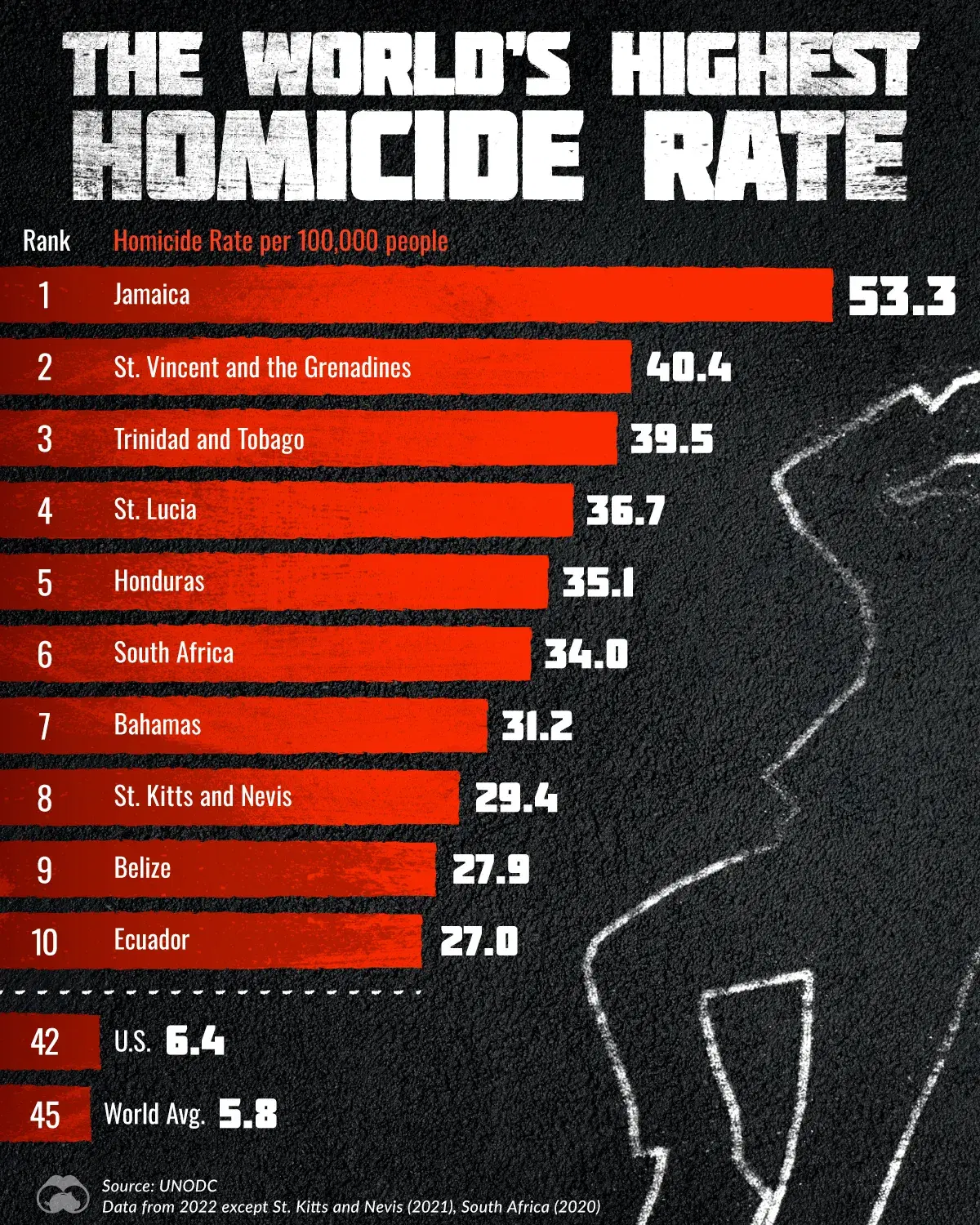
For the countries that still report, the latest year in the UNODC file published on 12 July 2026 is 2024: Singapore 0.17, Indonesia 0.41, Malaysia 0.69, the Philippines 4.31, against a world figure of 5.14 and a South-eastern Asian estimate of 2.07. Further afield, and on 2023, the United States was 5.76 and England and Wales 0.93. Thailand’s own 2011 figure of 4.79 is a decade and a half old, so it belongs beside those numbers only as history, not as a current ranking.
Contributing Factors
Several factors influence homicide rates in Thailand, including socioeconomic disparities, substance abuse, and access to firearms. Efforts to solve these problems, like community policing and social programs, are important for reducing violent crime over time
Safety Tips for Residents and Tourists
- Stay informed about local safety advisories, especially when traveling to regions with higher crime rates and potential for assault.
- Avoid isolated areas, particularly at night, and be cautious when consuming alcohol.
- Secure valuables and be vigilant in crowded places to prevent theft.
- In case of emergencies, contact local authorities or your country’s embassy for assistance.
Understanding Thailand’s homicide rates and the factors that affect them is important for both residents and visitors. By staying informed and taking the right precautions, people can help keep themselves and their community safe.
What the Data Supports About the Drivers
The honest answer is that the drivers cannot be measured from current Thai data, because the national series that would show them stops in 2011. What the UNODC file does support is the regional setting: South-eastern Asia is estimated at 2.07 homicide victims per 100,000 for 2024 against a world figure of 5.14, so the region sits well below the global level, while Thailand was above each of its immediate neighbours in every year it reported.
The same file says something more useful about method than any general claim about causes. In the last years for which Thailand has a breakdown, reported through WHO mortality data, firearms were the largest single category of homicide deaths: 2,064 of 3,323 in 2012, or 62 per cent, 1,304 of 2,387 in 2015, or 55 per cent, and 1,088 of 2,229 in 2016, or 49 per cent. Access to firearms is therefore not a marginal factor here, and any account of prevention that leaves it out is describing a different country.
The homicide rate in Thailand reflects a multifaceted issue that requires an equally complex approach to address effectively. Law enforcement matters, and so, on the firearm figures above, does access to guns; addressing socioeconomic gaps, mental health support and community programmes are commonly proposed alongside it, though Thai data since 2011 cannot show what works. By examining the factors that contribute to Thailand’s homicide rate and understanding regional and global comparisons, we gain a clearer picture of the challenges and opportunities for creating a safer society. If you have questions about safety in Thailand, please reach out to your embassy in Bangkok. This is especially important if you are concerned about assault or the homicide rate. You can also reach out to the Thai embassy or consulate in your home country.
FAQs about Homicide Rate in Thailand
What is the intentional homicide rate in Thailand?
The intentional homicide rate in Thailand is the number of unlawful deaths caused by others for every 100,000 people. It includes all intentional killings, excluding those resulting from killings in armed conflict.
How does Thailand’s murder rate compare to neighboring countries like Cambodia or Malaysia?
On the last comparable figures, for 2011, Thailand recorded 4.79 intentional homicides per 100,000 people, against 1.82 in both Cambodia and Malaysia, so its rate was more than double theirs. Malaysia still reports (0.69 in 2024); Thailand has reported no figure since 2011.
What factors contribute to the homicide rate in Thailand?
Many factors affect the homicide rate in Thailand. These include personal violence, drug crimes like meth trafficking, domestic disputes, and fights for control among groups.
How reliable are the crime statistics regarding intentional homicides in Thailand?
Crime statistics for Thailand vary in reliability because the sources are counting different things. The UNODC dataset carries what a country itself reports, and Thailand last reported a total homicide rate for 2011. National police statistics count recorded cases on Thai definitions, which are not the UNODC definitions. Wikipedia and the data aggregator sites mostly republish model estimates rather than measurements, which is why their numbers for recent years differ so widely. Where the three disagree, use the UNODC file and note the year at which it stops.
Are property crimes like burglary and robbery impacting the homicide rate in Thailand?
While property crimes such as burglary and robbery are prevalent, they do not directly impact the homicide rate. However, violent crimes associated with property crimes can sometimes escalate to murder, particularly as a result of domestic disputes.
What role does the prison system play in addressing the homicide rate in Thailand?
The prison system in Thailand helps reduce the homicide rate by holding offenders. However, overcrowding and rehabilitation issues can limit its effectiveness in managing prisoners. Efforts continue to improve conditions and reduce recidivism.
How has the homicide rate in Thailand changed in recent years, particularly in 2022?
There is no answer to this question in the international data. Thailand last appears in the UNODC series in 2011, at 4.79 per 100,000, and the rows for 2012 onward are empty. Any figure you see quoted for 2022 comes from a model or from national police counts that use a different definition, and those are not comparable either with the UN series or with each other.
How do international organizations like the Small Arms Survey influence understanding of Thailand’s homicide rate?
Organizations such as the Small Arms Survey provide valuable information. They analyze how small arms and light weapons contribute to violence. This information helps us understand what influences Thailand’s homicide rate.
What measures are being taken to reduce the intentional homicide rate in Thailand?
To lower the intentional homicide rate in Thailand, we can take several steps. These include improving law enforcement, tackling drug problems, enhancing public health strategies, and increasing community involvement to prevent violence.
Other relevant links:
- The Thai Penal Code, annotated, including the homicide offences in sections 288 to 294
- Criminal law in Thailand, for how a prosecution actually proceeds
Thai Law Updates, free by email
Plain-English updates on Thai law changes that affect foreigners: property, visas, marriage, business and wills. One short email a month from a firm practicing since 2006. No spam, unsubscribe anytime.