


Reviewed by ThaiLawOnline, a licensed Thai law firm practising in Thailand since 2006. Thai lawyer of record: Wichuda Atthamethakon, LL.M., Thai Bar Licence 3149/2556.
Last updated on
What changed: Transfer and mortgage registration fees are cut to 0.01% on qualifying residential property up to 7 million baht. The standard rates are 2% transfer and 1% mortgage.
LAWYER-DRAFTED TEMPLATE · ฿890
Superficies Agreement (Bilingual English & Thai): Own the House on Land You Cannot Own
A registered real right, annotated on the title deed itself: it survives a sale of the land and passes to your heirs. Adapted from an agreement our lawyers actually registered, with the honest renewal framework after Supreme Court 4655/2566, practice indications and a before-signing checklist. Word + PDF, updated August 2026. สัญญาให้สิทธิเหนือพื้นดิน ฉบับสองภาษา
Effective: 1 July 2026 to 30 June 2027, under two Ministry of Interior announcements published in the Royal Gazette on 1 July 2026.
LAWYER-DRAFTED TEMPLATE · ฿990
Land & House Sale and Purchase Agreement (Bilingual English & Thai)
Deposit with the double-return rule, clean-title warranties including road access, the tax split, and the foreign-buyer clause registering your lease, superficies or usufruct on the same transfer day. Word + PDF, updated August 2026. สัญญาจะซื้อจะขายที่ดินพร้อมสิ่งปลูกสร้าง
Who it affects: Individual Thai nationals only. Both announcements require the buyer to be a Thai national, so a foreign buyer registering under the foreign quota pays the standard 2% transfer fee.
What to do now: If you are a foreign buyer, budget the full 2%. The reduction still matters to you on resale, because a Thai buyer purchasing from you before 30 June 2027 may qualify.
Last verified: 1 August 2026 against the two Ministry of Interior announcements published in the Royal Gazette on 1 July 2026.
You found a beautiful plot of land in Chiang Mai. The price is right, the view is perfect, and the agent says you can buy it through a Thai company. Stop there. That “company structure” could land you in prison.
Table of Contents
Thailand land law is built on one bedrock rule: foreigners cannot own land. The Land Code Act of 1954 makes this clear. Section 86 shuts the door. Section 96 bis opens a crack, but only for those willing to invest 40 million THB.
We’ve practiced Thai property law since 2006. In that time, we’ve watched hundreds of foreigners get this wrong. Some lost money. Some lost their land. A few faced criminal charges. The New Intelligence Business Analytic System (IBAS) is now actively used by the Department of Business Development (DBD) to cross-reference shareholder income against their investment amounts. A Thai shareholder with a low declared income holding a multi-million baht property will now trigger an automatic investigation. This guide covers every legal angle, including the important Land Ownership Restriction, so you don’t join that list.
Table of Contents
The Land Code: Thailand’s Foundation for Land Ownership
The Land Code Act B.E. 2497 (1954) governs all land ownership in Thailand. Think of it as Thailand’s constitution for real property. Every purchase, transfer, lease, and title deed flows from this statute.
For Thai nationals, the Land Code grants full ownership rights. A Thai citizen can buy, sell, mortgage, subdivide, and inherit land without restriction. The same rules do not apply to foreigners.
What the Land Code Says About Foreign Ownership : Understanding Land Ownership Restriction in Thailand
Section 86 of the Land Code is blunt. Foreigners may acquire land only “by virtue of the provisions of a treaty giving the right to own immovable properties.” No such treaty exists today. Not with the United States. Not with the United Kingdom. Not with any country.
The code defines “foreigner” broadly. Under section 97 a company is treated as a foreigner if foreigners hold more than 49% of its registered capital, or if foreigners make up more than half of its shareholders by number. So a company needs both a Thai majority of the capital and a Thai majority of the shareholders before it can hold land.
Section 87 sets quantity limits even for foreigners who qualify under a treaty. Residential land tops out at 1 rai. Commercial land maxes at 1 rai. Industrial land allows up to 10 rai. Agricultural land permits up to 10 rai.
What Happens When a Foreigner Acquires Land Illegally
Section 94 spells out the consequences. The Director-General of the Land Department orders the foreigner to sell the land. The deadline falls between 180 days and one year. If the foreigner doesn’t sell, the government sells it for them. The Ombudsman has recommended amending section 94 so that such land is forfeited to the state instead of sold, and the Cabinet noted that recommendation on 24 June 2025. No amendment has been enacted.
Sections 111 and 113 add criminal penalties, for the foreigner who acquires land in breach of section 86 and for anyone who acquires land as a foreigner’s agent: up to two years in prison and fines up to 20,000 THB. That fine sounds small, but the real hit is losing the land itself.
The Department of Business Development’s Order No. 1/2569, in force from 1 April 2026, required company directors to sign a statement that the Thai shareholders had invested their own money. It was repealed by Order No. 2/2569, signed on 15 July 2026 and in force from 1 August 2026, which now sets the nominee checks at company registration. Our note on the nominee crackdown explains the current order.
Types of Land Title Deeds in Thailand
Not all land documents carry the same weight. Thailand has a hierarchy of title deeds, and understanding this hierarchy is essential before you sign anything. We’ve seen buyers pour money into land backed by documents that don’t prove ownership at all.
| Title Deed | Thai Name | Ownership Level | Survey Method | Can Be Sold? |
|---|---|---|---|---|
| Chanote (Nor Sor 4 Jor) | โฉนด (น.ส.4 จ.) | Full private ownership | GPS coordinates | Yes, immediately |
| Nor Sor 3 Gor | น.ส.3 ก. | Confirmed possession | Aerial survey | Yes, immediately |
| Nor Sor 3 | น.ส.3 | Confirmed possession | Not surveyed | Yes, with 30-day notice |
| Sor Kor 1 | ส.ค.1 | Claim notification only | None | No (transfer only) |
| Por Bor Tor 5 (not Ratchaphatsadu land, which is State land) | ภ.บ.ท.5 | Tax payment receipt | None | No (not a title) |
Chanote: The Gold Standard
A Chanote (Nor Sor 4 Jor) is the only document that proves full private land ownership. It bears the Red Garuda emblem. The Land Department surveys the plot using GPS grid coordinates and plants concrete markers at each boundary corner.
With a Chanote, the owner can sell, lease, mortgage, grant a usufruct, grant superficies, or subdivide the plot. All transactions register at the Land Office. If you’re buying property in Thailand (or arranging rights over it), insist on Chanote land.
Nor Sor 3 Gor: Close to Chanote
Nor Sor 3 Gor land has been surveyed by aerial photography with fixed boundary points. It functions almost identically to a Chanote. Sales, leases, mortgages, and usufructs all register at the Land Office.
The main difference: a Nor Sor 3 Gor can be upgraded to a Chanote through a formal land survey request. If you hold NS3G land, we recommend starting that upgrade process. It increases the land’s value and eliminates any boundary ambiguity.
Nor Sor 3: Handle With Care
Nor Sor 3 land has never been properly surveyed. The boundaries are approximate. That creates risk. Disputes with neighbors over boundary lines are common with NS3 land.
Selling NS3 land requires a 30-day public notice period. That delay exists because the lack of precise boundaries means third parties might have competing claims. You can still lease or mortgage NS3 land, but the absence of a survey makes transactions slower and riskier.
Practical tip: Never buy or lease land with only a Sor Kor 1 or Por Bor Tor 5 document. These are not ownership titles. A Sor Kor 1 is a claim notification from 1954. A Por Bor Tor 5 is a tax payment receipt. Neither proves you own the land.
Can Foreigners Own Land in Thailand?
The short answer: almost never. Section 86 of the Land Code blocks it. The law does include one narrow exception, and understanding it matters. If you want the routes compared side by side before the detail below, start with our overview of whether a foreigner can buy land in Thailand.
Section 96 Bis: The 40-Million-Baht Exception
Section 96 bis of the Land Code permits a foreigner to own up to 1 rai (1,600 square meters) of residential land. The requirements are strict:
First, you must invest at least 40 million THB (roughly USD 1.1 million) in Thai government bonds, approved mutual funds, or other assets “beneficial to Thailand’s economy.” The investment must stay in Thailand for a minimum of five years. If you pull the money out early, you lose the land ownership right.
Second, the Minister of Interior must approve your purchase. This isn’t rubber-stamped. The ministry reviews the application, the investment documentation, and the intended land use.
Third, you can only use the land for residential purposes. No commercial development. No agriculture. No subdivision for resale.
In over 20 years of practice, we can count on one hand the number of clients who pursued this route. Actually, I know a case but he was not our client. The 40 million THB threshold puts it out of reach for most people. And for those who can afford it, the bureaucratic process and ongoing restrictions make it unattractive compared to alternatives like condominium ownership.
Condominium Ownership: The Real Option for Foreigners
Section 19 of the Condominium Act B.E. 2522 (1979) is where most foreigners find their foothold. You can own a condo unit outright, in your own name, with full freehold title. No Thai spouse, no Thai company, no investment threshold.
The only limit: foreign ownership in any single condominium building cannot exceed 49% of the combined area of all the units in that building. Once that quota fills up, additional foreign buyers must lease rather than purchase. Check the building’s foreign quota before making an offer. Your lawyer can request this from the Land Office or the condo juristic person.
Payment must come from abroad. The buyer transfers funds from outside Thailand to a Thai bank account. The bank issues a Foreign Exchange Transaction Form (FETF), which proves the money originated overseas. Without the FETF, the Land Office will not register the transfer.
Legal Alternatives to Land Ownership
You can’t own the land. Fine. That doesn’t mean you have no rights over it. Thai law provides several mechanisms that give foreigners legitimate, enforceable interests in land. Each has different terms, protections, and trade-offs.
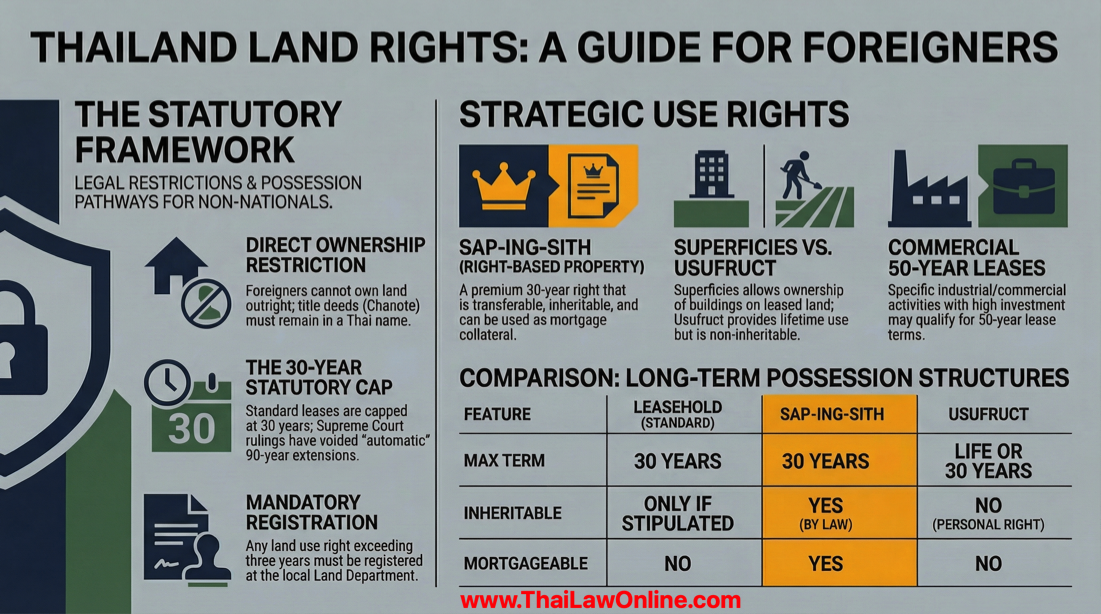
Registered Lease (Up to 30 Years)
The Civil and Commercial Code caps lease terms at 30 years (Section 540). A lease longer than three years must be registered at the Land Office (Section 538). Unregistered leases are enforceable but only up to three years.
Registration matters because it binds future owners. If the landlord sells the land during your lease, the new owner must honor the registered lease. An unregistered lease gives you no such protection.
Supreme Court Decision 4655/2566 (2023): a landowner granted a 30-year lease and, on the same day, promised two further 30-year terms, with the rent for all 90 years paid up front. The Court held that the parties meant to evade section 540, so the renewal part was void, and it refused to let it survive even as a personal promise between the parties, because that would defeat section 540. The tenant was evicted at the end of the first 30 years. Pre-arranged “30+30+30” structures of this kind had been widely marketed to foreigners. Section 540 allows a renewal only once the current term has ended, for up to 30 years from the renewal. If you hold a 30+30+30 lease, treat the current 30-year term as all you have.
Proposals for a 99-year maximum lease term floated through parliament in 2025. As of April 2026, they remain unenacted. Don’t rely on future law changes when making investment decisions.
Usufruct: Lifetime Land Use Rights
A usufruct (CCC Sections 1417 to 1428) grants the right to possess, use, and collect income from another person’s land. Western lawyers: think of it as similar to a life estate in common law jurisdictions.
The key advantage over a lease? A usufruct can last for the holder’s entire lifetime. There’s no 30-year cap. If you register a usufruct for life, you keep the right to live on and use the land until you die, regardless of what happens to the land’s ownership.
You can also set a usufruct for a fixed term (say, 30 years). Either way, it must be registered at the Land Office to bind future owners. A usufruct is personal: you can’t sell the right itself or pass it to your heirs (section 1418), though unless the grant forbids it you may transfer its exercise to someone else (section 1422). When the usufructuary dies, the right terminates and the land returns to the owner unencumbered.
For more detail on costs and registration, see our usufruct agreement guide.
Superficies: Own the Building, Not the Land
Superficies rights (CCC Sections 1410 to 1416) allow a foreigner to own structures built on another person’s land. You own the house. Someone else owns the dirt underneath it.
The maximum term is 30 years, or for the lifetime of the landowner or the superficiary (section 1412). Registration at the Land Office is required. When the superficies ends, you may remove your building and restore the land; if the landowner gives notice that they will buy the building at market value, you cannot refuse without reasonable ground (section 1416).
We commonly pair superficies with a lease but attention, you can only register one them. The foreigner leases the land for 30 years and holds a superficies right over the building. That combination gives you two layers of protection: the right to occupy the land and separate ownership of the structure on it. Superficies remains the superior tool for villa owners because, unlike a standard lease or usufruct, it is inheritable by law and separates the building ownership from the land title.
Sap Ing Sith: A Newer Option
The Sap Ing Sith Act B.E. 2562 (2019) created a new type of right over immovable property. It grants the holder the right to possess, use, and benefit from land or buildings for up to 30 years. Unlike a usufruct, a Sap Ing Sith right is transferable and inheritable.
That’s the critical difference. If you hold a Sap Ing Sith right and you die, your heirs inherit the remaining term. If you need to sell, you can transfer the right to a buyer. A usufruct dies with you. A Sap Ing Sith survives you.
It’s still relatively new, and Land Office staff in some provinces are less familiar with the registration process. But the law is clear, and we’ve registered Sap Ing Sith rights for clients across multiple provinces. Read our detailed breakdown of the Sap Ing Sith right and the Sap Ing Sith Act B.E. 2562.
Comparing Your Options: Lease vs. Usufruct vs. Superficies vs. Sap Ing Sith
| Feature | Lease | Usufruct | Superficies | Sap Ing Sith |
|---|---|---|---|---|
| Governing law | CCC Sec. 537-571 | CCC Sec. 1417-1428 | CCC Sec. 1410-1416 | Sap Ing Sith Act 2562 |
| Maximum term | 30 years | Lifetime or fixed term | 30 years or lifetime | 30 years |
| Transferable? | With landlord consent (s.544) | Only its exercise (s.1422) | Yes, unless the grant says otherwise (s.1411) | Yes |
| Inheritable? | As a rule no: an ordinary lease ends on the tenant’s death (Supreme Court 3254/2545), unless it carries special reciprocal obligations | No (dies with holder) | Yes, unless the grant says otherwise (s.1411) | Yes (remaining term) |
| Covers buildings? | Land, buildings or both | Land and buildings | Building ownership | Land and buildings |
| Income rights? | Sub-lease possible | Yes (rent, crops, etc.) | Building income | Yes |
| Registration required? | Over 3 years: yes | Yes | Yes | Yes |
| Binds future owners? | If registered | If registered | If registered | If registered |
Which one fits your situation depends on your age, budget, goals, and how long you plan to stay. A 65-year-old retiree might prefer a lifetime usufruct. A 35-year-old investor might want a Sap Ing Sith for its transferability. We help clients choose the right structure every week. Talk to us before committing.
The Nominee Trap: Why “Thai Company” Structures Fail
Here’s the scheme: a foreigner sets up a Thai limited company. Thai nominees hold 51% of shares. The foreigner holds 49% but controls the company through side agreements, preferred shares, or proxy arrangements. The company buys land. The foreigner effectively “owns” the land through the company.
It’s illegal. And in 2025 and 2026, Thai authorities are cracking down harder than ever.
The Law
The Foreign Business Act B.E. 2542 (1999) prohibits foreigners from operating restricted businesses through nominees. Holding land for a foreigner is caught by the Land Code itself: a Thai who acquires land as a foreigner’s agent commits an offence under section 113, and the land can be ordered sold under section 94. Where the nominee company also runs a business reserved to Thais, the Foreign Business Act adds its own offence (section 36).
The Enforcement Numbers
By 2025, Thai authorities were reported to have identified over 46,000 nominee companies suspected of holding land for foreigners. 852 prosecutions were launched. The estimated damages reached 15.1 billion THB. The government deployed AI-powered screening tools to detect nominee patterns in shareholder structures.
A proposed Nominee Transactions Act would classify nominee land ownership as a predicate offense for anti-money laundering laws. That would allow asset seizure without a criminal conviction. As of April 2026, the act hasn’t passed yet. But the direction is clear.
The Penalties
| Violation | Penalty | Source |
|---|---|---|
| Foreigner operating a reserved business through nominees | Up to 3 years prison or a 100,000 to 1,000,000 THB fine, or both | Foreign Business Act s.36 |
| Foreigner acquiring land in breach of s.86, or a Thai acquiring it as the foreigner’s agent | Up to 2 years prison or a fine up to 20,000 THB, or both | Land Code ss.111, 113 |
| Failure to dispose of illegal land | Government-forced sale | Land Code Sec. 94 |
| Thai nominee shareholder in a reserved business | Up to 3 years prison or a 100,000 to 1,000,000 THB fine, or both | Foreign Business Act s.36 |
Real scenario: We’ve seen clients who bought land through a nominee company 15 years ago with no problems. Then the crackdown hits. The Land Department flags the company. Investigators examine the shareholder structure. The Thai “shareholders” can’t explain where they got the money to invest. The company dissolves. The land goes to forced sale. The foreigner loses everything. Don’t assume that time makes a nominee structure safe. It doesn’t.
For a deeper look at recent enforcement actions, see our article on nominee crackdowns in Thailand.
Buying Property Through a Thai Spouse
Many foreigners married to Thai nationals assume they can buy land through their spouse. That’s partly true, but the rules are stricter than most people realize.
A Thai spouse can buy land in their own name. The Land Code doesn’t restrict Thai citizens from owning land just because they married a foreigner. But the Land Office will require both spouses to sign a declaration confirming that the purchase funds are the Thai spouse’s separate property (Sin Suan Tua), not marital property (Sin Somros).
Under section 1474 of the Civil and Commercial Code, property acquired during the marriage is marital property unless it is one spouse’s personal property under section 1471, such as a gift or inheritance. If you use marital funds to buy land, the foreigner spouse has a claim to that property. The Land Office wants to make sure that doesn’t create a back-door path to foreign land ownership.
In practice, the Thai spouse signs a document stating the money is theirs alone. The foreign spouse signs a document renouncing any claim to the land. These declarations are standard. But they carry real consequences. If the marriage ends in divorce, the foreign spouse has no claim to land purchased this way, even if marital funds actually paid for it.
We advise every client in a mixed marriage to get a prenuptial agreement that addresses property ownership. It protects both spouses and prevents nasty surprises during divorce proceedings.
Due Diligence Before Buying or Leasing Land
Every land transaction in Thailand needs a proper due diligence check. We’ve stopped clients from making terrible purchases more times than we can count. Here’s what a thorough check covers:
Step 1: Verify the Title Deed
Go to the local Land Office. Request a title search on the land’s Chanote or NS3G number. Confirm the registered owner matches the seller. Check for mortgages, liens, easements, usufructs, leases, or court orders registered against the title. All of these show up in the Land Office records.
Step 2: Confirm Boundaries
For Chanote land, the GPS boundary markers should match the physical plot. Walk the land. Check the corner markers. Compare the title deed measurements to what you see on the ground. For NS3 or NS3G land, consider hiring a licensed surveyor to verify boundaries before signing anything.
Step 3: Check Zoning and Land Use
Thailand has zoning laws. Some land sits in protected forest zones, national park buffer areas, or agricultural-only zones. Building a house on agricultural-zoned land requires a zoning change, which may or may not be granted. Check with the local municipality or tambon administrative organization.
Step 4: Environmental and Access Issues
Does the land have road access? Landlocked plots exist in Thailand, and accessing them can require a servitude (right of way) over a neighbor’s land. Check for flood zones, coastal erosion risk, and environmental protection orders.
Step 5: Hire a Lawyer
Don’t rely on the seller’s agent, the developer’s lawyer, or Google. Hire your own independent Thai property lawyer. They work for you, not the other side. A proper due diligence package costs a fraction of what you’ll lose if something goes wrong.
Land Transfer Fees and Taxes
Transferring land at the Land Office triggers several fees and taxes. The allocation between buyer and seller is negotiable, but custom in most of Thailand is to split the transfer fee equally.
| Fee/Tax | Rate | Basis |
|---|---|---|
| Transfer fee | 2% of appraised value | Land Office appraised value. A reduced rate of 0.01% applies until 30 June 2027 on qualifying residential property up to 7 million baht, but only where the buyer is an individual Thai national, so foreign buyers should budget the full 2%. |
| Stamp duty | 0.5% of appraised or sale price (whichever is higher) | Only if no SBT applies |
| Specific Business Tax (SBT) | 3.3% of appraised or sale price (whichever is higher) | If sold within 5 years of acquisition |
| Withholding tax | Progressive rate (1-35%) | Based on appraised value and years held |
| Lease registration fee | 1% of total rent over lease term | For registered leases over 3 years |
The Land Office uses its own appraised value, which is typically lower than market value. The transfer fee and an individual seller’s withholding tax are calculated on the appraised value; specific business tax and stamp duty use the appraised value or the declared sale price, whichever is higher. Trying to declare a lower sale price to reduce taxes is risky. The Land Office can reject a declared price that falls below their appraisal. For a full breakdown, see our property taxes guide.
Last reviewed: 26 September 2026. Read in Thai: Land Code sections 86, 87, 94, 96 bis, 97, 111, 112 and 113; Civil and Commercial Code sections 540, 544, 1411, 1412, 1416, 1418 and 1422; Foreign Business Act section 36; Department of Business Development Order No. 2/2569 clause 1 as recorded in our reference file; and Supreme Court decisions 4655/2566 and 3254/2545, each read to its disposition. Not verified: the enforcement statistics, which are press figures.
Frequently Asked Questions
Can a foreigner own land in Thailand?
Normally no. Section 86 of the Land Code allows it only where a treaty grants that right, and none is in force. The only exception is Section 96 bis, which requires a 40 million THB investment and ministerial approval. That buys you up to 1 rai of residential land.
What is a Chanote title deed in Thailand?
A Chanote (Nor Sor 4 Jor) is Thailand’s highest land title. It proves full private ownership with GPS-surveyed boundaries. You can sell, lease, mortgage, or subdivide Chanote land without restriction.
What happens if a foreigner uses a Thai nominee to buy land?
Nominee land ownership is illegal. A Thai who acquires land as a foreigner’s agent, and the foreigner who acquires it, face up to two years in prison or a fine up to 20,000 THB under the Land Code (sections 111 and 113), and the land can be ordered sold (section 94). If the company also runs a business reserved to Thais, the Foreign Business Act adds up to three years or a fine of 100,000 to 1,000,000 THB.
How long can a foreigner lease land in Thailand?
The maximum registered lease term is 30 years under CCC Sections 538 and 540. Renewal clauses are contractual, not guaranteed. In Decision 4655/2566 (2023) the Supreme Court held a pre-arranged renewal void.
What is the difference between a usufruct and a lease in Thailand?
A usufruct (CCC Sections 1417-1428) grants the right to use land and collect income for life or a fixed term. A lease (CCC Section 540) is capped at 30 years per term. A usufruct can last for your entire lifetime. A lease cannot.
Can a foreigner own a condo in Thailand?
Yes. Section 19 of the Condominium Act lists the foreigners who may own a unit outright, and Section 19 bis then caps foreign ownership in any single building at 49% of the combined area of all the units, measured when the condominium was registered.
What is Section 96 bis of the Thailand Land Code?
Section 96 bis allows a foreigner to own up to 1 rai (1,600 sq m) of residential land. You must invest at least 40 million THB in Thai bonds or qualifying assets. The Minister of Interior must approve the purchase
How ThaiLawOnline Can Help
We’ve handled property transactions across Thailand for over two decades. Our team reviews title deeds, negotiates leases, registers usufructs, and structures Sap Ing Sith rights. We also clean up messes when clients come to us after things have gone wrong.
Whether you’re buying a condo in Bangkok, leasing land in Phuket, or trying to secure your family home through a usufruct, we can guide you through the legal process from start to finish.
Browse our full range of Thai property law services, or schedule a consultation with one of our property lawyers.
Key Takeaways
- Foreigners cannot own land in Thailand. Section 86 of the Land Code allows it only where a treaty grants that right, and none is in force. The only exception (Section 96 bis) requires 40 million THB in investment.
- A Chanote title deed is the only document proving full land ownership. Always insist on Chanote land.
- Foreigners can own condos outright under the Condominium Act, within the 49% foreign quota per building.
- Registered leases max out at 30 years. The 2025 Supreme Court ruling killed the 30+30+30 renewal structure.
- Usufructs can last a lifetime. Sap Ing Sith rights last up to 30 years but are transferable and inheritable.
- Nominee structures are illegal. Penalties include prison, fines, and government-forced land sales. Enforcement is accelerating.
- Always conduct due diligence. Hire an independent lawyer. Verify the title deed at the Land Office before signing anything.
Thai Law Updates, free by email
Plain-English updates on Thai law changes that affect foreigners: property, visas, marriage, business and wills. One short email a month from a firm practicing since 2006. No spam, unsubscribe anytime.