


Reviewed by ThaiLawOnline, a licensed Thai law firm practising in Thailand since 2006. Thai lawyer of record: Wichuda Atthamethakon, LL.M., Thai Bar Licence 3149/2556.
Last updated on
Update, 13 September 2026. Use the current checklist of the Thai embassy or consulate responsible for your application. Residence evidence, bank history, police certificates and payable fees differ between missions. See the London checklist and Washington checklist.
This is the DTV filing guide. Use it for document preparation, e-Visa steps and how to put the application together. For current eligibility rules, the 500,000 THB financial test, stay limits and 2026 rule changes, read our main DTV requirements guide.
You’re sitting in a Bangkok coffee shop at 8 AM, working on your laptop while sipping Thai iced coffee. Your calendar shows meetings with clients in New York and London. Thailand feels like home, but your visa situation is uncertain. You’ve been on tourist visas, visa runs, and ED visas. None of them were designed for someone like you.
Then in July 2024, Thailand launched something different: the Digital Nomad Visa, or DTV.
The DTV changed the game for remote workers, freelancers, and people who want to live in Thailand long-term. It’s the visa the Thai government created specifically for digital nomads. It’s legal, affordable, and comes with real protections under Thai law. In this article, you will learn the DTV Application steps and everything you need to know about the Destination Thailand Visa.
At ThaiLawOnline, we’ve worked in Thai law for 20 years. We’ve helped thousands of foreign professionals understand visas, residency rules, and tax implications. We’ve seen visa systems change, immigration rules tighten, and policies shift unexpectedly. We know what works and what doesn’t.
This guide covers everything you need to know about the DTV visa in 2026. We’ll explain the legal basis, walk through the application process, break down the costs, and address the tax rules that affect you. We’ll also show you how the DTV compares to other visa options, because it’s not always the best choice for everyone.
Whether you’re thinking about applying now or considering your options, use our Thai visa finder to compare alternatives, or read on for the full DTV breakdown.
Table of Contents
What Is the Destination Thailand Visa (DTV)?
The Destination Thailand Visa is a new legal visa category created by the Thai government. It is specifically for digital nomads, remote workers, and people on work-related or soft power trips. The government approved it through Cabinet Resolution on May 28, 2024, and it took effect on July 15, 2024.
The legal foundation sits in the Immigration Act B.E. 2522 (1979). Section 35 gives the Director General of the Immigration Bureau authority to set stay periods for different visa categories. The DTV exists because the government used this authority to create something new.
Key Legal Basis
Four Ministerial Notifications were published in the Royal Gazette on July 15, 2024, establishing the DTV as an official visa category under the Immigration Act.
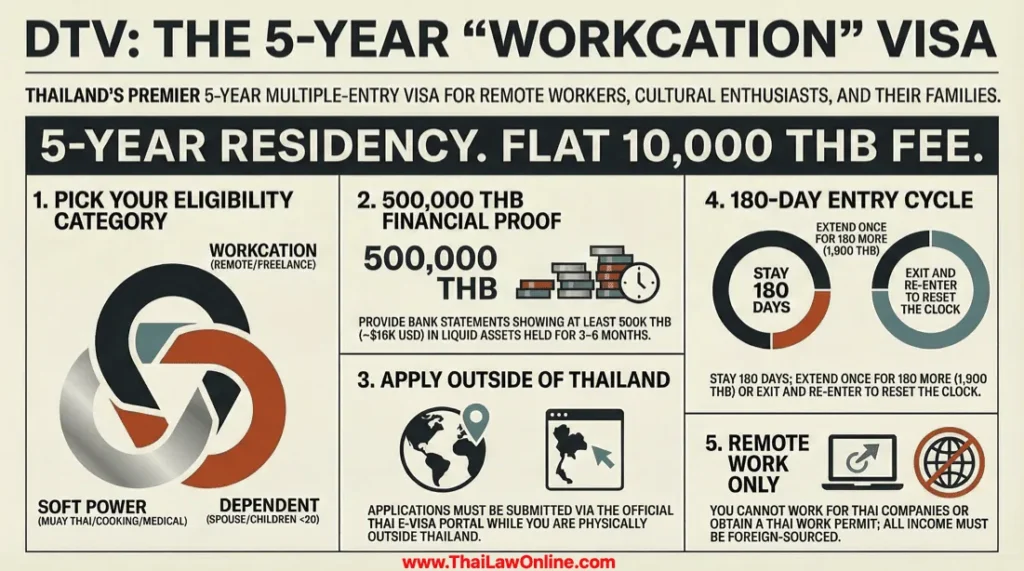
Here’s what makes the DTV unique: it’s a 5-year multiple entry visa. Each entry allows you to stay for 180 days. After 180 days, you can extend once for another 180 days. That is up to 360 days per entry, subject to extension approval if you use the extension.
The DTV base fee is THB 10,000; pay the amount and currency published by the deciding mission. Local fees are fixed by the mission and should not be calculated simply from today’s exchange rate: London publishes £300, Washington USD 400 and Vientiane 10,000 baht in cash. Helsinki publishes EUR 350 and Ho Chi Minh City USD 340. The residence evidence, statement period and police-certificate age also differ by post: see the mission-by-mission comparison in our requirements guide before you order documents. Apply from outside Thailand, at the mission covering a country where you are a national or a permanent resident, with the residence evidence that mission accepts.
The DTV permits multiple entries during its five-year validity. Each admission remains subject to immigration control. The land-border visa-exemption limit is a separate rule and is not a DTV entry cap.
One critical point: the DTV does not include a work permit. We’ll explain what that means and how it affects you in the work permit section below.
Who Can Apply for the Thailand Digital Nomad Visa?
DTV applications use three groups: workcation; Thai soft-power activities, including medical treatment; and the spouse and children under 20 of a DTV holder. Select the category shown on the responsible mission’s checklist. Medical applicants provide hospital or medical-centre evidence within the activity group. See our DTV requirements guide.
Track 1: Workcation and Remote Work
This is the track for digital nomads and remote workers. You qualify if you’re a freelancer, you work remotely for an overseas company, or you’re a business owner with clients outside Thailand. The government calls this the “Workcation” or remote work track.
You must be at least 20 years old and have a valid passport with at least 6 months of validity remaining. You need to show THB 500,000 (roughly $14,500 USD) in savings. A foreign bank account works fine. The money needs to be in your name, and your bank statements should show the balance has been there consistently. Applicant younger than 20 yo can be dependant on applications of parents as example.
Your background matters. You can’t have a history of long visa overstays. The immigration system checks your records. If you’ve overstayed visas in the past, your DTV application will likely be rejected.
Track 2: Soft Power Activities
The soft power track is for people coming to Thailand for activities that don’t involve work. These include Muay Thai training, cooking classes, music festivals, sports training, seminars, or art classes. The government created this track to attract people who want to stay longer for these specific purposes. Medical treatment is included in the DTV2 activity group and requires evidence from the hospital or medical centre.
Choose a genuine programme and obtain a confirmation letter identifying the provider, activity, duration and schedule. Course length alone does not guarantee approval. Confirm the deciding mission’s current activity requirements before paying a provider.
You meet the same age requirement (20 years old) and passport requirement (6+ months validity). The financial requirement is also THB 500,000, and the background check applies here too.
Important Eligibility Rules
Language schools no longer qualify for the DTV. The government closed this pathway in 2025. If you’re planning to study Thai language, you’ll need a different visa type, like the ED visa.
You can’t work for Thai employers or Thai companies on a DTV. We’ll cover the work rules in detail later, but this is a hard line. The DTV is only for remote work with overseas clients.
You must be 20 years old. There’s no exception for younger applicants. If you’re 19, you’ll need to wait or choose a different visa option. Children under 20 can piggyback on their parent’s visa under the “Spouse/Children” track.
DTV Visa Requirements: Documents You’ll Need
The documents you need depend on which track you’re applying under. Below is a complete breakdown for each track.
| Document Type | Workcation/Remote Work Track | Soft Power Track |
|---|---|---|
| Valid Passport Copy | Required (6+ months validity) | Required (6+ months validity) |
| Bank Statement | Required (THB 500,000 savings) | Required (THB 500,000 savings) |
| Work Contract or Offer Letter | Required (from overseas employer) | Not required |
| Proof of Business Ownership | Required if self-employed | Not required |
| Activity Registration/Enrollment | Not required | Required (proof of activity) |
| Supporting Letter from Activity Provider | Not required | Required (from gym, school, clinic, etc.) |
| Health Insurance | Not a DTV document requirement: no official embassy checklist (including the USA, UK and Finland) lists health insurance for the DTV as of August 2026. Strongly recommended for your own protection, and consular officers can always request extra documents case by case. | Not a DTV document requirement: no official embassy checklist (including the USA, UK and Finland) lists health insurance for the DTV as of August 2026. Strongly recommended for your own protection, and consular officers can always request extra documents case by case. |
| Criminal Record Check | Required at every mission since 31 August 2026; the accepted issuer and maximum age are set by the mission | Required at every mission since 31 August 2026; the accepted issuer and maximum age are set by the mission |
| Proof of nationality or permanent residence | Required since 31 August 2026. An address in the country is no longer enough: you must be a national or a permanent resident of the country where you apply, and the mission sets the accepted document | Required since 31 August 2026. An address in the country is no longer enough: you must be a national or a permanent resident of the country where you apply, and the mission sets the accepted document |
Let’s break down the most important documents.
Bank Statements and Financial Proof
The THB 500,000 requirement is the most common reason applications get rejected. You need to show the equivalent of THB 500,000 in a bank account in your name. This can be a foreign bank account. You don’t need a Thai bank account to apply. In fact, opening a Thai bank account on a DTV is difficult (most banks still require a work permit).
Show financial evidence meeting the deciding mission’s THB 500,000-equivalent requirement. Prepare a clear funds history and explain unusual deposits. The required statement period and acceptance of joint, sponsored or family accounts depend on the mission; a recent deposit is not a published universal ground for automatic refusal.
Dependents are not exempt from the money rule: official checklists ask each spouse or child’s file for a bank statement with an ending balance of no less than 500,000 THB. Some posts accept one family statement covering the combined amount with proof of relationship, and an extra 500,000 THB per dependent on top of that is not a published nationwide rule. For a family of three, plan on roughly 1,500,000 THB across your accounts, and use the checklist of the embassy that will decide the file.
Work Documentation for Workcation Track
If you’re applying under the remote work track, you need proof that you actually work for an overseas company. This could be a work contract, an offer letter, or documentation of your freelance clients. The document needs to show the company or client is overseas, not in Thailand.
If you’re self-employed, you’ll need proof of your business. This could be a business registration certificate, tax returns, or copies of invoices from overseas clients.
Activity Documentation for Soft Power Track
If you’re applying under the soft power track, you need to prove enrollment or registration in your activity. If you’re training Muay Thai, get a letter from the gym confirming your enrollment. If you’re taking cooking classes, get a document from the school. If you’re getting medical treatment, get a letter from the clinic.
Address Proof
Two different address questions come up, and applicants often confuse them.
1. Where you are when you apply. Since 31 August 2026 this is not about where you are, it is about where you belong: the deciding mission must cover a country where you are a national or a permanent resident, and a short visit to a neighbouring country no longer establishes eligibility. The document that proves it is set by the mission, and the missions differ: Los Angeles lists a valid driving licence, a valid U.S. visa or a Permanent Resident Card, while Ho Chi Minh City accepts only a Vietnamese Temporary or Permanent Residence Card.
2. Your address in Thailand after arrival. This is not part of the visa application. You give a Thai address on the arrival card (TDAC), your landlord or hotel files the TM30 notification within 24 hours of your arrival, and you will need a lease, utility bill or condo purchase agreement in your name later, when you apply for the 180-day extension or file a 90-day report. Keep those documents from day one.
How to Apply for a Thailand Digital Nomad Visa (Step-by-Step)
Since January 2025, the DTV application process has been fully online through the Thai e-visa system. You can’t submit a paper application at an embassy anymore. Everything happens on thaievisa.go.th.
Where You Can Apply: The 31 August 2026 Rule Change
Since 31 August 2026 a Thai mission accepts a DTV application only from a national or a permanent resident of the country where it is submitted, and the file must include a certificate of criminal record clearance issued by the authorities of your country of nationality or of the country where you apply. The Royal Thai Embassy in Vientiane published the change on its visa application page on 28 August 2026, and the Royal Thai Consulate-General in Los Angeles publishes the same effective date. It is a mission notice, not a Royal Gazette instrument. Applications submitted and paid in full before 31 August 2026 are decided under the old rules, and payment rather than submission is the cut.
What each mission accepts as residence evidence differs, and some of it falls short of permanent residence: Los Angeles lists a valid driving licence, a valid U.S. visa or a Permanent Resident Card; London requires proof of permanent residence in the UK, Ireland or the British Overseas Territories, such as indefinite leave to remain; Ho Chi Minh City accepts only a Vietnamese Temporary or Permanent Residence Card and refuses a temporary residence declaration in terms. The criminal record certificate has its own mission rules: London specifies one issued within six months, such as an ACRO certificate, Washington and Los Angeles an FBI certificate within three months, and Ho Chi Minh City Vietnamese Criminal Record Certificate No. 2. Read the checklist of the mission that will decide your file.
Step 1: Check Your Eligibility
Before you start, confirm you meet all eligibility requirements. You’re 20 years old or older. Your passport has 6+ months of validity. You have or can access THB 500,000. You have no history of long visa overstays. You’ve identified which track you’re applying under (Workcation or Soft Power).
Step 2: Gather All Required Documents
Collect every document listed in the table above that applies to your track. Make digital copies of everything. The system requires PDF files, JPG images, or PNG images. Poor quality scans cause rejections. Make sure documents are clear and readable.
Step 3: Create Your Account on thaievisa.go.th
Visit the official Thai e-visa website. Create an account using your email address. You’ll receive a confirmation email. Click the link to activate your account. Save your login credentials somewhere safe.
Step 4: Complete the Online Application Form
Log in and select “Digital Nomad Visa (DTV)” as your visa type. Choose your track (Workcation or Soft Power). Fill in all required information accurately. Your name needs to match your passport exactly. Your email and phone number should be current. You’ll use these for status updates and payment confirmation.
Step 5: Upload Your Documents
Upload each document according to the system’s requirements. The system clearly labels what goes where. Don’t skip anything marked as required. If your document is in a language other than English or Thai, you may need to provide a certified translation.
Step 6: Pay the Application Fee
The DTV base fee is THB 10,000; pay the amount and currency published by the deciding mission. Local fees are fixed by the mission and should not be calculated simply from today’s exchange rate. Follow the payment methods displayed by the mission or e-Visa portal and retain the receipt.
Step 7: Wait for Processing
Processing typically takes 5 to 15 business days. During this time, immigration may request additional documents or information. Check your email frequently. If they ask for something, respond quickly. Delays often happen because applicants don’t respond to requests in time.
Step 8: Location Verification
In 2026, the immigration system has introduced location verification at Thai embassies and consulates for some applicants. If you’re selected, you’ll receive an email with instructions. You’ll need to appear at the embassy in your jurisdiction for a brief interview or document verification. This step isn’t required for all applicants, but it’s becoming more common.
Step 9: Receive Your E-Visa Approval
Once approved, you’ll receive an email with your e-visa document. Download and print this document. It’s a PDF that shows your visa number, validity dates, and entry conditions. You can also save the digital copy to your phone.
Step 10: Enter Thailand Within Visa Validity
You must enter Thailand within the validity dates shown on your e-visa. When you arrive at immigration at the airport or land border, present your printed e-visa along with your passport. Immigration will stamp your entry. You might need to show your TDAC (Thailand Digital Arrival Card which replace TM6 in 2025).
One thing this does not change: the DTV is issued abroad. You cannot obtain or convert one inside Thailand, and since 31 August 2026 the mission that decides your file must be the one covering a country where you are a national or a permanent resident.
DTV Visa vs Thailand Privilege vs Other Options
The DTV isn’t the only option for staying in Thailand long-term. Let’s see how it stacks up against the main alternatives.
| Feature | DTV | Thailand Privilege | Tourist visa | Non-Immigrant B |
|---|---|---|---|---|
| Purpose | Workcation, qualifying activities or eligible dependants | Membership-based long stay | Tourism | Business or employment-related purposes |
| Stay | 180 days per entry; one extension up to 180 days subject to approval | Normally one year per admission; follow visa and membership conditions | Normally 60 days; possible 30-day extension | Normally 90 days initially; extension conditions depend on purpose |
| Work permission | No Thai employment authorization from the visa alone | No work authorization from membership alone | No ordinary employment authorization | A work permit or applicable exemption is separate |
| Financial evidence and fees | THB 500,000-equivalent evidence; mission checklist and local visa fee apply | Current package price and membership terms apply | Mission-specific visa fee and financial evidence | Mission and extension-category requirements; no universal THB 800,000 rule |
| Permanent residence | No automatic entitlement | No automatic entitlement | No automatic entitlement | Separate eligibility and application; approval is not automatic after five years |
DTV vs Thailand Privilege
Thailand Privilege is a membership-based long-stay programme with package-specific fees and benefits. Check the current Privilege guide before comparing costs. Membership assistance does not make an immigration extension automatic.
Compare the deciding mission’s DTV fee with the current Privilege membership package. The programmes have different purposes, eligibility rules and benefits; neither guarantees every later immigration decision.
The DTV is better for digital nomads on a budget. The Privilege visa is better if you want maximum convenience and don’t mind the cost.
DTV vs Tourist Visa
A single-entry tourist visa normally permits a 60-day stay, with a possible 30-day extension subject to approval. Visa validity, permission to stay and visa exemption are different concepts. The limit on visa-exempt land entries is not a general limit on tourist visas or DTV entries.
The DTV gives you 180 days per entry, and you can extend for another 180 days. That is up to 360 days without leaving Thailand, subject to extension approval. You don’t need visa runs. It’s more stable and costs less over time.
DTV vs Non-Immigrant B (Work Visa)
The Non-Imm B requires a Thai employer. You need a job offer from a Thai company. The company has to apply for your work permit. It’s much more complicated than the DTV.
A Non-Immigrant B visa does not itself authorize employment. A work permit or applicable exemption is a separate requirement. Confirm both immigration status and work authorization before starting work for a Thai employer.
For digital nomads working for overseas companies, the DTV is simpler and faster. For people planning to work in Thailand for Thai employers, the Non-Imm B is the right choice.
Thailand Digital Nomad Visa Cost Breakdown
Here’s what the DTV actually costs you, year by year. We’ve included all the fees and expenses you’re likely to encounter.
| Expense Item | Fee (THB) | Fee (USD) | Frequency |
|---|---|---|---|
| DTV Application | 10,000 | ~$275 | Initial only |
| Extension of Stay (once per entry) | 1,900 | ~$52 | Per entry (optional) |
| 90-Day Reporting | 0 | Free | Every 90 days |
| Health Insurance (annual) | 20,000 to 100,000 | ~$550 to $2,700 | Recommended |
First Year Total Cost
Your first year will cost you the application fee (THB 10,000) plus optional expenses. If you extend your stay once in year one and buy health insurance, you’re looking at roughly THB 32,000 to THB 112,000 (about $875 to $3,050). The exact amount depends on which health insurance plan you choose.
Subsequent Years
The DTV remains valid for multiple entries during its five-year validity. A fresh admission using the valid multiple-entry visa does not require buying a separate re-entry permit. An in-country extension has its own fee; budget separately for insurance, travel and any document costs.
90-Day Reporting
Every 90 days, you need to report to immigration. This is free. Many people do it online now. You just need to notify immigration of your address and confirm you’re still in Thailand. It takes 10 minutes online.
Health Insurance Considerations
Health insurance isn’t technically required by law yet. But it’s strongly recommended. Thailand has excellent healthcare, but it’s not free for foreigners. A decent expat health insurance policy costs THB 20,000 to THB 100,000 per year depending on coverage and age.
Some health insurers specifically cover DTV visa holders. Others don’t. Ask before you buy.
To be clear about a common myth: no official DTV checklist requires health insurance. We checked the MFA e-visa checklist and the embassy pages in Washington, London and Helsinki (August 2026): none lists insurance as a DTV document. The $50,000 insurance figure you may see elsewhere belongs to the O-A and O-X retirement visas, not the DTV. Insurance is still strongly recommended, and any consulate can request additional documents, so check the checklist of the post where you apply.
Re-entry Permits Explained
A valid multiple-entry DTV is used for a fresh admission when you return to Thailand. A separate re-entry permit is not normally needed for that purpose. Check your visa expiry and admission stamp before travelling.
Do not include optional re-entry permit costs as a routine DTV charge. Seek case-specific advice if travel falls near visa expiry or involves a different immigration status.
Tax Implications for DTV Visa Holders
This is critical. Tax rules changed significantly in 2024, and they directly affect DTV holders. Many digital nomads misunderstand the rules and face major problems.
Thai Tax Residency and the 180-Day Rule
Under section 41 paragraph three of the Thai Revenue Code, anyone who stays in Thailand for periods totalling 180 days or more in any tax year is a resident of Thailand for tax purposes. For individuals the Thai tax year runs from 1 January to 31 December, so what counts is the number of days you are physically present in Thailand across that year. It makes no difference which visa you hold, or whether you entered on a visa exemption. The test is the same for everyone.
Being a tax resident does not mean Thailand taxes your worldwide income. A resident is taxed on Thai-sourced income, and on foreign income only when that income is brought into Thailand. Our guide to personal income tax in Thailand covers the rates and how filing works.
Foreign Income Is Now Taxable
This is where most of the confusion sits, and one point is worth getting right: the Revenue Code was not amended in 2024. Section 41 paragraph two has long provided that a resident who earns income from employment, from a business carried on abroad or from property situated abroad pays Thai tax on it upon bringing that income into Thailand, and that remittance trigger is still the law. What changed on 1 January 2024 is the Revenue Department’s own reading of it, issued as Departmental Instruction Por. 161/2566, with Por. 162/2566 exempting foreign income earned before that date. Under the earlier practice, foreign income remitted in a later tax year than the one in which it was earned fell outside the charge; under Por. 161/2566 it is assessable in the year it is remitted, whenever it was earned. Foreign income you do not bring into Thailand is not assessable under section 41.
So the practical question for a tax resident is not whether you earn overseas income but whether you bring it into Thailand. If you do, assume it is assessable and report it. A departmental instruction is the Revenue Department’s interpretation rather than an Act of Parliament, so it can be revised the way it was made; we track the current position, including the proposed exemption, on our Thailand remittance tax exemption status page.
DTV Holders Staying Under 180 Days
If you spend fewer than 180 days in Thailand in a calendar year, you’re not a tax resident. Non-residence does not itself remove filing obligations: Thai-sourced assessable income remains relevant, subject to the applicable thresholds and exemptions. That follows from section 41 itself, whose second paragraph applies only to a resident of Thailand. Revenue Department Departmental Instructions Por. 161/2566 and Por. 162/2566 bite only once you are a tax resident: they treat foreign income earned from 1 January 2024 onwards as assessable when a tax resident brings it into Thailand.
Many digital nomads plan to leave Thailand for a few weeks or months each year specifically to stay under 180 days. This is legal. You can do visa runs, take trips abroad, or work from other countries for parts of the year.
The Double Tax Treaty Issue
Thailand has tax treaties with many countries to prevent double taxation. The treaty between Thailand and the United States (or your home country) may allow you to claim credits for Thai taxes paid against taxes owed in your home country. But you need to file taxes in both places.
We recommend talking to a tax accountant familiar with both Thai and your home country’s tax systems. The rules are complex, and a mistake can cost you significantly.
What You Should Do Right Now
If you’re on a DTV and earning overseas income, you need to track your days in Thailand accurately. Keep records of dates you left and dates you returned. If you hit 180 days in the calendar year, you’re approaching tax residency. If you hit 180 days, you’re a tax resident and need to file Thai taxes.
Consult with a Thai tax accountant. They can help you understand your personal situation. Some digital nomads restructure their year to stay under 180 days. Others decide to pay Thai taxes. The right choice depends on your circumstances.
Internal Reference: For more detailed information, see our guide on personal income tax in Thailand.
Work Permit Rules and Legal Boundaries
This is where many DTV holders get confused. Let’s be absolutely clear: the DTV does not include a work permit.
What You Can Do Without a Work Permit
On a DTV, you can work remotely for an overseas employer. You can work for an overseas client if you’re a freelancer. You can run an overseas business. The key word is “overseas.” The work is not performed in Thailand for a Thai employer or Thai client.
You’re not physically working in a Thai office. Your clients are outside Thailand. Your paycheck comes from outside Thailand. This is legal on the DTV without a work permit.
What You Cannot Do
You cannot work for Thai employers. You cannot work for Thai companies. You cannot provide services to Thai clients for payment. You cannot work at a job location in Thailand. All of this requires a work permit, and the DTV doesn’t come with one.
The instrument that governs this is the Emergency Decree on Managing the Work of Aliens B.E. 2560 (2017), as amended by the Emergency Decree (No. 2) B.E. 2561 (2018). It is what creates the work permit and what defines, in section 5, the work that requires one. The Foreign Business Act B.E. 2542 (1999) is a different statute with a different subject: it governs which businesses a foreigner may operate, through its three annexed lists and its licensing regime, and it does not decide whether an individual may take a job. Violation can result in fines, deportation, and blacklisting from re-entering Thailand.
The Gray Areas
Some activities live in gray areas. If you consult with Thai clients online about strategy, is that “working for a Thai client”? If you attend meetings at a co-working space in Bangkok with clients from your overseas company, is that “working in Thailand”? These edge cases are technically restricted but rarely enforced.
Immigration enforcement of work permit violations is inconsistent. Some expats work in gray areas for years without problems. Others face sudden enforcement action. The safest approach is to stay clearly on the legal side: work for overseas clients only, don’t take a job with a Thai company, and don’t work from a Thai office for Thai bosses.
How to Get a Work Permit if You Need One
If you want to work for a Thai employer legally, you need to switch visas. You’d apply for a Non-Immigrant B visa (work visa) while in your home country. Your Thai employer would apply for a work permit on your behalf once you arrive. If you’re thinking of setting up a business in Thailand, you’ll also need proper corporate registration. It takes time and involves immigration paperwork, but it’s the legal way to do it.
Internal References: For more information, see our guides on work permits in Bangkok and prohibited jobs for foreigners in Thailand.
2025-2026 Regulatory Updates You Should Know
The DTV landscape has changed rapidly. Here are the major regulatory updates that affect you right now.
Thailand Digital Arrival Card (TDAC) Requirement
Starting May 1, 2025, all travelers arriving in Thailand must complete the Thailand Digital Arrival Card (TDAC) within 72 hours of arrival. This is an online form that replaces the TM.6 paper form. You get a TDAC registration number, and you need to show it at immigration or to police if asked. It must be submitted within 72 hours of arrival.
The TDAC is free. It takes about 10 minutes to complete online. You’ll receive a QR code via email. It’s very straightforward.
Visa Run Crackdown (November 2025)
The two-entry restriction concerns visa-exempt entries through land borders, with nationality exceptions under the applicable scheme. It is not a universal annual visa-run limit, a DTV entry cap or a general waiting period between all entries. See the border-entry guide.
Use the entry basis recorded on your admission stamp. A DTV admission and a visa-exempt admission have different conditions. Do not assume the exemption rules determine the stay granted on a valid DTV.
Visa Exemption: the 30-Day Cut Applies from 15 September 2026
The Ministry of Interior announcements were published in the Royal Gazette on 31 August 2026. Official Thai travel guidance identifies 15 September 2026 as the start of the new visa-exemption arrangements. For travel planning, use the date of admission to Thailand, not the booking date or the date your flight departs.
Admissions up to and including 14 September 2026 fell under the previous 60-day exemption. From 15 September 2026, the new tourism exemption provides up to 30 days for the 60 listed countries and territories, including Canada, France and India. Separate arrangements apply to other nationalities. Check the permission-to-stay date stamped in your passport and follow the conditions attached to your admission.
Read the official announcement and our updated visa-exemption guide.
None of this changes a DTV entry itself, which is stamped for 180 days on its own terms. It matters if you plan to bridge a gap between DTV entries on a visa exemption stamp, because that stamp is 30 days for entries from 15 September 2026.
Language School Pathway Closed
Language schools are no longer an acceptable primary reason for the DTV soft power track. The government closed this pathway in 2025. If you’re studying Thai language, you need an ED visa instead. The ED visa is designed for full-time students.
Location Verification at Embassies
In 2026, Thai embassies have started requiring location verification appointments for some DTV applicants. When you apply, you may be asked to appear at the embassy in your jurisdiction for an in-person verification. This could be a brief interview or just document verification. It’s becoming standard practice.
If you’re selected, respond quickly. Delays in showing up for your verification appointment can result in application rejection.
Bringing Your Family on a DTV Visa
You can bring family members on a DTV, but they need their own visas. The DTV isn’t a family visa like some other countries offer. Each family member applies individually.
Who Qualifies as Family
Your spouse can apply for a DTV. Children under 20 can apply. Adult children (20 and older) can apply if they meet the standard DTV eligibility requirements. Spouses and children under 20 apply under the DTV dependent category, as the family of a DTV applicant or holder, with proof of relationship. Adult children qualify on their own merits under their own category.
Financial Requirements for Family Members
A spouse and children under 20 apply separately as dependants, with the principal holder’s DTV and evidence of relationship. Follow the mission’s financial and supporting-document checklist for each family member. Do not assume every child needs a separate personal account containing THB 500,000.
Prepare the family’s applications together so names, relationship documents and financial evidence are consistent. Obtain mission-specific advice if a spouse or child relies on the principal applicant’s funds.
Documentation for Spouses
A spouse applies under the dependant category, using the principal holder’s DTV, a marriage certificate and the remaining documents required by the deciding mission. A dependant spouse does not need to qualify independently as a remote worker.
Documentation for Children
Children under 20 of a DTV holder apply under the dependant category, with birth or adoption records and the mission’s other required documents. Enrolling a child in a course is not required for this dependant route.
The Practical Challenge
Getting a whole family through the DTV process is time-consuming. Each person applies separately. Each person needs financial documentation. Each person needs approval. Coordinating four or five applications at once is complicated.
Consider the dependant DTV route for an eligible spouse and children before arranging separate study visas. Compare alternatives where a family member does not meet the dependant criteria.
Frequently Asked Questions
Can I work for Thai clients on a DTV visa?
No. The DTV specifically excludes work for Thai employers or Thai clients. You can work remotely for overseas companies or clients only. Working for Thai entities requires a Non-Immigrant B visa and a work permit. If immigration discovers you’re working for a Thai client, your visa can be canceled and you could face deportation. This is a hard line in Thai law.
How much money do I need for a Thailand digital nomad visa?
You need to show the equivalent of THB 500,000 (roughly USD 14,500) in a bank account in your name. A foreign account is fine and is what most applicants use. You do not need a Thai bank account, and most Thai banks will not open one for a DTV holder. The required bank-statement history depends on the deciding mission; follow its current checklist. Each dependent’s file generally needs to show 500,000 THB as well; some posts accept one family statement with proof of relationship, so follow the checklist of the embassy deciding the file.
Can I extend my DTV visa beyond 180 days?
Yes. Each 180-day entry can be extended once for another 180 days. That is up to 360 days per entry, subject to extension approval. After the extension period ends, you can leave Thailand and re-enter on the same DTV to get another 180-day entry. The DTV itself is valid for 5 years, so you can do this multiple times.
Can I open a Thai bank account on a DTV visa?
This is difficult and some will say impossible. Most Thai banks require a work permit or long-term visa (like a Non-Immigrant B or retirement visa) to open an account. The DTV is still new. In 2025, some banks started to refuse opening bank accounts for DTV holders and we hope this will change but nobody knows when. The law doesn’t forbid it but banks do not do it since 2025.
What happens if I overstay my DTV visa?
Overstaying a DTV is serious. You’ll face fines (THB 500 per day, up to THB 20,000 maximum for the first overstay). You’ll be flagged in the immigration system. You could be deported and banned from re-entering Thailand for a period. Future visa applications will be harder. Even one day of overstay can complicate things. Don’t let your stay expire accidentally. Set a reminder and plan ahead.
Can I convert a DTV to another visa type while I’m in Thailand?
No. DTV visas can’t be converted to other types while you’re in Thailand. If you need a different visa (like a Non-Immigrant B for work), you’d need to leave Thailand, apply for the new visa from abroad, and return. The DTV must be left as-is or allowed to expire while you’re here on a different visa category.
Is the DTV visa the same as the Thailand Privilege (formerly Elite) Visa?
No. They’re completely different programs. The DTV is a government immigration visa that costs THB 10,000 and requires proof of overseas work or specific activities. Thailand Privilege, formerly the Thailand Elite Visa, is a private membership program costing the current package price and offering package-specific benefits and immigration assistance. The DTV is for remote workers. Thailand Privilege is for wealthy individuals who want premium service and convenience.
How ThaiLawOnline Can Help
The DTV is a significant decision. You’re committing to a visa that will define your legal status in Thailand for the next 5 years. Getting it right matters.
ThaiLawOnline has practised Thai immigration law since 2006. We know what embassies accept, what they refuse, and why, because we see both outcomes every month.
If you’re considering the DTV, we can help you evaluate whether it’s the right fit for your situation. We can review your eligibility, identify potential problems in your application, and help you gather the right documents. We can explain the tax implications specific to your circumstances. We can answer your questions about work restrictions and legal boundaries. Since 2006 we have handled visa and immigration work for thousands of foreign clients, and every DTV application we have prepared since the visa launched in July 2024 has been approved. Our DTV service is 10,000 THB and comes with a refund guarantee: if an application we prepared and reviewed is refused, we reimburse our fee in full. The government visa fee is paid at the deciding mission’s published rate and is separate from our service fee and refund terms.
We also maintain guides on related topics that affect DTV holders: legal guide for digital nomads in Thailand, Thai visa finder tool, personal income tax in Thailand, and moving to Thailand guide.
For comprehensive legal support with your DTV application or any Thailand legal matter, visit our legal services page or reach out through our website.
Key Takeaways
- The DTV is a legal 5-year multiple entry visa for digital nomads and remote workers, launched July 15, 2024, under the Immigration Act B.E. 2522 (1979).
- Each entry provides 180 days in Thailand, extendable once for another 180 days, costing just THB 10,000 (~$275).
- You must be 20+ years old, have a valid passport with 6+ months validity, and show liquid funds equivalent to THB 500,000, usually on a personal bank account in your home country (a Thai bank account is not required).
- Apply online through thaievisa.go.th. You can’t apply from inside Thailand. Processing typically takes 5-15 business days.
- The DTV does not include a work permit. You can work remotely for overseas employers only, not for Thai companies or clients.
- If you spend 180+ days in Thailand in a calendar year, you become a tax resident and must report foreign income under Section 41 of the Revenue Code.
- Compare the mission’s DTV fee and evidence requirements with current Thailand Privilege packages and tourist-visa conditions.
- Check the mission’s current residence and document requirements and complete TDAC when required. The visa-exempt land-entry cap is separate from DTV admissions.
- Eligible family members apply separately as dependants, with relationship and financial evidence accepted by the deciding mission.
- Consult a tax accountant to understand your personal tax situation. Overstaying has serious consequences. Get professional advice before applying.
DTV document guidance updated 13 September 2026 against the linked London and Washington mission checklists. Requirements vary by mission; use the checklist applicable to your application. This date records the corrections described above, not a fresh verification of every statutory and tax proposition on this page.
Thai Law Updates, free by email
Plain-English updates on Thai law changes that affect foreigners: property, visas, marriage, business and wills. One short email a month from a firm practicing since 2006. No spam, unsubscribe anytime.